





Electric Bottle and Food Pouch Warmers: How to Choose and Use One Safely
How electric bottle and food pouch warmers work, how to pick a safe one, and how to heat breastmilk, formula and baby food without burns or hot spots.
On this page
- Key points
- What an all-in-one bottle and pouch warmer is
- Water bath vs steam warmers: how they heat
- Comparing your warming options
- How to choose a safe bottle and food pouch warmer
- Safe warming by feeding stage and age
- How to warm breastmilk, formula and food pouches safely
- What health bodies say in Australia, the UK, the US and Canada
- Cleaning, descaling and kitchen safety
- Common mistakes to avoid
- Frequently asked questions
- Sources
Short answer: An all-in-one electric warmer heats baby bottles and food pouches in one small machine. The safest models use a gentle warm water bath instead of hot steam. Always swirl or stir the milk or food after warming. Test a drop on the inside of your wrist before you feed your baby. Never use a microwave to warm a bottle.
This guide follows advice from health bodies in Australia (NHMRC, Australian Breastfeeding Association, Raising Children Network), the UK (NHS), the US (CDC, American Academy of Pediatrics) and Canada (Health Canada, Canadian Paediatric Society).
Key points
- Not every baby needs warm milk: Healthy babies can safely drink breastmilk or formula cold or at room temperature.
- Water bath beats steam for breastmilk: Gentle warm water protects nutrients in breastmilk and lowers the risk of hot spots.
- Swirl and test every time: Always mix the milk or food well and check it on your wrist. It should feel lukewarm, not hot.
- Skip the keep-warm trap: Do not leave milk sitting in a warmer for hours. Warm bacteria grow fast.
- Empty pouches into a bowl: Squeeze warmed food from a pouch into a clean bowl and stir it well before feeding.
- Watch the cord and steam: Keep the warmer far back on the bench so a child cannot pull it down.
What an all-in-one bottle and pouch warmer is
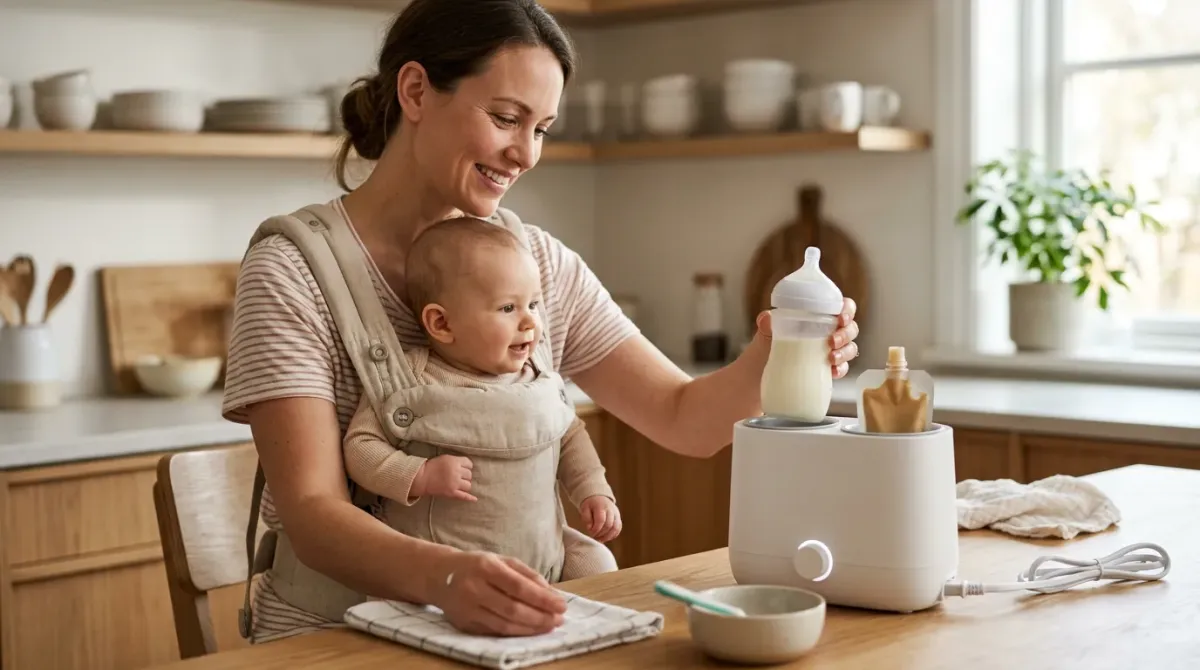
An all-in-one electric bottle and food pouch warmer is a small kitchen appliance. It plugs into a wall socket. It has a heating chamber where you place a baby bottle, a jar, or a soft baby food pouch.
You add water to the chamber and pick a setting. The machine heats the water, which then warms the milk or food inside the container.
Older warmers were often narrow and only fit standard plastic bottles. Newer all-in-one models have a wider basket. This lets them hold wide-neck bottles, glass bottles, breastmilk storage bags, jars, and squeeze pouches.
Do you actually need one?
You do not have to own an electric warmer to feed a baby safely. Health services in Australia, the UK, the US and Canada all say that healthy babies can drink milk straight from the fridge or at room temperature.
Still, many babies prefer warm milk, especially if they are used to breastmilk straight from the breast. Other parents find a warmer helpful at night when a baby wakes up hungry and tired.
A bowl or jug of warm tap water does the same job for free. An electric warmer simply makes the temperature more steady and frees up your hands.
Water bath vs steam warmers: how they heat
Electric warmers heat your baby's milk or food in one of two ways. Knowing the difference helps you pick the right machine.
Warm water bath warmers
A water bath warmer fills the space around the bottle with warm water. A gentle heater keeps the water at a steady, low temperature. Heat moves slowly through the bottle wall into the milk.
- Pros: Heats evenly. Very low risk of overheating breastmilk. Easy to avoid scalding hot spots.
- Cons: Takes a little longer, often several minutes. Uses more water in the chamber.
Steam warmers
A steam warmer puts a small amount of water on a hot plate at the bottom. The water boils and turns into hot steam. The steam surrounds the bottle or pouch and heats it fast.
- Pros: Very fast. Handy when a hungry baby is crying at two in the morning.
- Cons: Steam is very hot. It can easily overheat the outside edge of the milk while the middle stays cool. It can damage delicate parts of breastmilk if left too long. It also poses a steam burn risk when you lift the lid or basket.
Some newer all-in-one warmers offer both modes. You can pick a gentle water bath for breastmilk and a faster setting for food jars or pouches.
Comparing your warming options
Here is how electric warmers compare with simple kitchen methods. Every safe method needs a swirl and a wrist check at the end.
| Method | How it works | Speed | Best for | Main risks to watch |
|---|---|---|---|---|
| Electric water bath warmer | Sits bottle or pouch in steadily heated water | Moderate (a few minutes) | Expressed breastmilk, formula, pouches | Leaving milk inside too long on keep-warm |
| Electric steam warmer | Surrounds bottle or pouch with hot steam | Fast | Formula, food jars, quick feeds | Overheating milk, steam burns on hands, hot spots |
| Bowl or jug of warm water | Sits bottle or pouch in warm tap water | Moderate | Occasional feeds, travel, low budget | Water cools down; must never use boiling water |
| Microwave oven | Heats liquid unevenly with radio waves | Very fast | Not recommended for baby bottles | Dangerous hidden hot spots that burn a baby's mouth |
Why is a microwave unsafe for baby bottles? Microwaves heat food and liquid unevenly. The outside of the bottle can feel cool while the milk inside has pockets hot enough to scald a baby's mouth and throat. Health bodies in Australia, the UK, the US and Canada all advise against microwaving baby bottles.
How to choose a safe bottle and food pouch warmer
Do not buy a warmer just because it has lots of buttons or a glowing screen. Focus on safety, fit, and easy cleaning.
1. Check the basket size and shape
Measure your bottles before you buy. Wide-neck bottles, angled bottles, and silicone pouches need a wider chamber. A lift-out basket with a long handle is very useful. It keeps your fingers away from hot water and steam when you pull the bottle or pouch out.
2. Look for automatic shut-off
Pick a warmer that turns itself off when the timer ends or when the water runs dry. Sleep-deprived parents can easily forget a machine is running. Boil-dry protection stops the heater from melting plastic or starting a fire.
3. Check the temperature controls
Simple timers can be tricky because a glass bottle heats differently from a thick plastic bottle. Cold milk from the fridge also takes longer than room-temperature milk. Look for clear settings by bottle material, milk volume, and starting temperature. Even better, look for a gentle water-bath mode.
4. Avoid food-contact plastics with risky chemicals
Look for warmers and baskets made from food-grade, BPA-free and phthalate-free materials. BPA (bisphenol A) and phthalates are chemicals used in some plastics. Food Standards Australia New Zealand (FSANZ) and the U.S. Food and Drug Administration (FDA) monitor BPA in food contact items. Many baby products now avoid them altogether.
Keep in mind that heating plastic at very high temperatures can make it break down faster. Research published in Nature Food found that preparing formula in polypropylene plastic bottles with very hot water releases tiny plastic particles called microplastics. Using a gentle water bath rather than boiling steam helps reduce heat stress on plastic bottles.
5. Check local electrical safety
Buy your warmer from a trusted retailer in your own country. Make sure it has the right plug and voltage for your local power supply. Never use cheap overseas imports with loose travel adapters. An appliance that holds water and electricity needs proper local electrical testing and approval marks.
6. Pick an easy-to-clean tank
Mineral buildup from tap water, called limescale, coats heating plates quickly. Narrow corners and hidden crevices trap old water and grow mould. Choose a warmer with a wide opening so your hand and a soft cloth can reach the bottom easily.
Safe warming by feeding stage and age
What you warm changes as your baby grows. Use this table to match your warmer use to your baby's stage.
| Age stage | What you are warming | Safe warmer advice |
|---|---|---|
| Newborn (0 to 3 months) | Expressed breastmilk or infant formula | Use a gentle water bath for breastmilk. Follow strict formula hygiene rules. Always check temperature on your wrist. |
| 3 to 6 months | Larger bottles of breastmilk or formula | Check that bigger bottles still fit under the lid or in the basket. Remember cold milk does not have to be warmed if baby accepts it. |
| 6 to 12 months | Milk plus purees, mashed food, jars or pouches | Stir food pouches well in a bowl after warming. Test with a clean spoon before offering to baby. |
| 12 months and over | Cow's milk or toddler meals | Many toddlers drink cold milk from an open cup or straw cup. Use the warmer only for soft meals if needed. |
How to warm breastmilk, formula and food pouches safely
Milk and solid food behave differently when heated. Follow the right steps for each one.
Warming expressed breastmilk
Breastmilk contains living cells and helpful proteins that protect your baby. High heat can break these down. The Australian Breastfeeding Association (ABA) and the NHS say you should never boil breastmilk or heat it in a microwave.
- Wash your hands with soap and water before touching bottles or breastmilk.
- Thaw frozen breastmilk in the fridge overnight, or hold the sealed container under cool, then warm, running tap water.
- Place the bottle or sealed milk bag into the warmer's basket.
- Use a gentle warm water bath setting. Heat only until the milk is body temperature or slightly cool.
- Lift the bottle out using the basket or a cloth.
- Swirl the bottle gently to mix the fat layer back in. Do not shake breastmilk hard, as vigorous shaking is unnecessary and creates air bubbles.
- Squirt a drop onto the inside of your wrist. It should feel neutral or gently warm, never hot.
- Feed your baby right away.
Once frozen breastmilk has thawed and been warmed, do not refreeze it. If your baby does not finish a warmed bottle of breastmilk, throw away the leftovers after the feed (most health services say within 1 to 2 hours).
Warming infant formula
Powdered infant formula is not sterile. It can sometimes carry harmful bacteria. Health services have strict rules for making up formula safely, and warming comes after that.
In the UK, the NHS tells parents to make each formula feed fresh with freshly boiled water cooled to no less than 70°C to kill bacteria, then cool it quickly under cold water before feeding. In Australia, the NHMRC and Raising Children Network advise boiling water and cooling it to room temperature or lukewarm before mixing, or storing pre-made bottles safely in the fridge for up to 24 hours. The US CDC says if your baby is under 2 months old, was born early, or has a weak immune system, use liquid ready-to-feed formula or mix powder with water heated to at least 70°C.
When warming a chilled bottle of pre-made or ready-to-feed formula:
- Place the bottle in the warmer with the teat and cap on loosely, or follow the warmer's manual.
- Warm it for just a few minutes until lukewarm.
- Put the cap on tight and swirl or gently shake to even out the heat.
- Test a drop on your wrist before feeding.
- Throw away any formula left in the bottle after 1 to 2 hours, or right after the feed finishes.
Never leave a bottle of formula sitting in a warmer on a 'keep warm' setting. Warm formula is a perfect breeding ground for bacteria that cause tummy bugs.
Warming baby food pouches and jars
Food pouches are handy when you are out or short on time. They also heat unevenly if you are not careful.
- Check the pouch label. Make sure the pouch is safe to place in warm water. Never put a pouch with metal foil into a microwave.
- Keep the cap screwed on while the pouch sits in the water bath so tap water does not leak into the food.
- Take the pouch out once warm. Let it sit for a minute so heat spreads through the puree.
- Squish the closed pouch gently with your fingers to mix the food inside.
- Open the cap and squeeze the food into a clean bowl. Stir it well with a spoon.
- Test a small taste with a clean spoon (not the one your baby uses, so you do not pass germs from your mouth) before feeding.
Why use a bowl instead of letting your baby suck from a warm pouch? First, stirring in a bowl breaks up hot pockets that can burn a baby's tongue. Second, sucking straight from a pouch can make it harder to see how hot the food is. Third, health bodies like the NHS and Raising Children Network encourage spoon feeding and cup drinking rather than sucking purees from pouches, as it helps babies learn to chew and protects baby teeth.
If you only want half a pouch, squeeze half into a bowl before warming. Put the capped, untouched rest of the pouch straight into the fridge and use it within 24 hours (check the packet for its exact limit). Never save food that has already been warmed or touched by your baby's spoon.
What health bodies say in Australia, the UK, the US and Canada
Health experts across all four countries agree on the core safety rules for warming milk and baby food. None of them require you to buy an electric warmer. All of them focus on avoiding burns and stopping bacteria from growing.
| Country | Official bodies | Key advice on warming milk and baby food |
|---|---|---|
| Australia | NHMRC, Australian Breastfeeding Association, Raising Children Network, Pregnancy, Birth and Baby, Product Safety Australia (ACCC) | Warm bottles in a jug or bowl of warm water or a bottle warmer. Never microwave bottles or breastmilk. Swirl gently and test on your wrist. Do not reheat leftovers. |
| UK | NHS, NHS Start for Life, Office for Product Safety and Standards (OPSS) | Stand bottles in warm water or use a warmer; never use a microwave. Stir warmed baby food well and check temperature before feeding. Never reheat food more than once. |
| US | CDC, American Academy of Pediatrics (HealthyChildren.org), U.S. FDA, U.S. CPSC | Warm bottles under warm running water or in a bowl of warm water. Never microwave. Test milk on your wrist. Throw away warmed formula within 1 to 2 hours. |
| Canada | Health Canada, Canadian Paediatric Society (Caring for Kids) | Warm bottles in warm water for a few minutes, never in a microwave. Shake or swirl and test on the back of your hand or wrist. Keep electric cords away from children. |
Product safety regulators in all four countries — Product Safety Australia (ACCC), OPSS in the UK, the CPSC in the US, and Health Canada — also track recalls for faulty kitchen appliances and baby gear. Registering your warmer or checking recall lists now and then is a smart habit.
Cleaning, descaling and kitchen safety
An electric warmer holds warm water every day. Without simple cleaning, it can quickly get slimy or rusty.
Daily cleaning
- Unplug the warmer and let it cool completely before you clean it.
- Tip out all leftover water after each day, or after each use if the manual says so.
- Wipe the inside chamber and basket with a clean damp cloth and mild dish soap, then rinse well.
- Never put the electric base in the sink or dishwasher. Water inside the plug or motor can cause electric shock.
Weekly or monthly descaling
If you live in an area with hard tap water, chalky white crust will build up on the heating plate. This makes the warmer slower and less accurate.
- Mix equal parts white household vinegar and water (or citric acid if your manual prefers it).
- Pour enough mix into the cold chamber to cover the heating plate.
- Let it soak for 30 minutes to an hour, or run a short warm cycle if your manual tells you to.
- Tip out the vinegar mix and rinse the chamber well with fresh water.
- Wipe dry with a clean towel.
Check your warmer's booklet before using vinegar, as some brands give exact steps.
Burn and cord safety in the kitchen
Hot water and steam cause painful burns in seconds. Babies and toddlers have thin skin that burns faster and deeper than adult skin.
- Put the warmer at the back of the kitchen bench, well away from the edge.
- Tuck or coil any spare power cord behind the machine so a toddler cannot grab and yank it.
- Keep your baby out of your arms when you lift a hot bottle or pouch out of steam.
- Always unplug the warmer when you are done.
Common mistakes to avoid
Most warmer problems happen when parents are tired and in a rush. Here are the main traps to skip.
| Do | Don't |
|---|---|
| Use a gentle water bath for breastmilk | Boil breastmilk or blast it with long steam cycles |
| Swirl milk and stir food in a bowl | Feed straight from a warmer without mixing first |
| Test temperature on your wrist or with a clean spoon | Guess the heat by touching the outside of the bottle |
| Throw away unfinished warmed milk or food | Reheat the same bottle or pouch a second time |
| Empty and wipe the tank every day | Leave old water sitting in the warmer all week |
| Loosen lids or caps slightly if warming jars | Seal glass jars tight under high heat, which can crack glass |
| Keep the warmer far back on the bench | Leave cords dangling where a crawling child can pull them |
1. Using the 'keep warm' mode for hours
Many warmers have a 24-hour keep-warm button. Parents often think they can leave a bottle of milk inside all night so it is ready at 3:00 AM. That is unsafe for milk. Bacteria multiply fast in warm milk. You can keep plain boiled water warm for a short time if your manual allows it, or keep a clean empty bottle ready, but never hold mixed formula or breastmilk warm for hours.
2. Trusting the outside of the bottle
Thick plastic and silicone bottles block heat. The outside of a silicone bottle can feel cool while the milk inside is very hot. Always test a drop of milk on your skin.
3. Forgetting to check glass jars for cracks
Moving a cold glass jar straight from the fridge into boiling steam can shock the glass and make it crack. Let chilled glass jars sit on the bench for a few minutes first, or use a gentle warm water bath. Check the glass for chips before you spoon-feed your baby.
4. Heating sealed pouches in a microwave instead
If your warmer is busy, do not toss a food pouch into the microwave. Many pouches have thin aluminium layers that spark in a microwave. Even microwave-safe pouches can burst or create scalding pockets of puree.
Frequently asked questions
Can I leave a bottle of formula in the warmer overnight?
No. Once formula is mixed and warmed, bacteria can grow inside it quickly. Health bodies advise using warmed formula right away and throwing out any leftovers after 1 to 2 hours. Keep pre-made bottles in the fridge and warm each one only when your baby wakes up.
Does an electric warmer destroy nutrients in breastmilk?
A gentle water bath warmer kept at body temperature does not harm breastmilk. Very high heat, boiling, or microwaving can break down helpful proteins and immune cells in breastmilk. Always pick the lowest, gentlest setting when warming expressed breastmilk.
How long does an all-in-one warmer take to heat a bottle or pouch?
Most water bath warmers take around 3 to 7 minutes. Steam warmers can take 2 to 4 minutes. The exact time depends on how cold the milk is, how much is inside, and whether the bottle is glass, plastic, or silicone. Glass warms faster than thick silicone.
Can I use filtered or distilled water in the warmer tank?
Yes. You can use tap water in most warmers, though hard tap water leaves white mineral crust on the heater plate. Using filtered or distilled water helps cut down limescale so you do not have to descale as often. Remember the water in the tank does not go into your baby's milk.
Is it safe to warm a frozen breastmilk bag straight in the warmer?
Check your warmer's manual first. Many water bath warmers have a defrost setting made for frozen bags. Do not use a hot steam setting on a frozen plastic storage bag, as high heat can melt or split the bag seams. Thawing the bag in the fridge overnight is the safest and easiest method.
Why do health experts say babies do not even need warm milk?
Cold or room-temperature milk is completely safe for healthy full-term babies. Heating milk is only for comfort, not safety. If your baby happily drinks milk straight from the fridge, you can save time and skip warming altogether. Ask your doctor or midwife if your baby was born early or has special health needs.
Can I reheat a baby food pouch if my baby did not finish it?
No. Food should only be reheated once. If you warmed the whole pouch and your baby only ate half, throw the rest away. To avoid waste, squeeze half of a cold pouch into a clean bowl, warm only that bowl, and put the capped rest straight in the fridge.
Sources
- Australian Breastfeeding Association – Preparing expressed breastmilk
- Raising Children Network – Baby formula: how to make and store it
- Pregnancy, Birth and Baby – Food preparation and safety
- Food Standards Australia New Zealand – Bisphenol A (BPA)
- NHS Best Start in Life (UK) – Storing and reheating food
- NHS Start for Life (UK) – Storing breast milk
- CDC – Infant formula preparation and storage
- Caring for Kids (Canadian Paediatric Society) – Feeding your baby in the first year
Related guides
More Feeding & Baby Food →
Electric Bottle Sterilisers and Dryers: How They Work, How to Choose, and Safe Use
Baby Food Makers: How to Choose, Prepare and Store Baby Food Safely

Electric Steam Bottle Sterilisers and Dryers: How They Work and How to Choose