













Supporting a Late Talker at 15–24 Months: Simple Ways to Help and When to Seek Advice
Simple ways to support your toddler’s talking, what to notice, and when to ask a health professional about speech, language and hearing.

On this page
- What people mean by a late talker
- What to notice between 15 and 24 months
- How to make everyday moments helpful
- Parentese, wait time and gestures
- Use play, books and routines
- A comparison of ways to support communication
- When to ask for help
- What an assessment may involve
- Common mistakes that can add pressure
- Make a simple communication note
- Official guidance in Australia, the UK, the US and Canada
- Frequently asked questions
- Sources and further help
- Sources
Short answer: Talk, play and share books with your toddler each day. Follow what interests them. Use short, clear phrases, then pause. Accept pointing, sounds and signs as communication. If you worry about your child's talking, understanding, hearing or progress, speak with a health professional. You do not need to wait for a certain birthday.
Children learn to communicate at different speeds. A slow start does not tell you what a child will do later. A check can help show whether support may help. You know your child best. Ask for help when something concerns you.
What people mean by a late talker
A late talker is a toddler who uses fewer spoken words than many children of the same age. The phrase describes what a child is doing now. It is not a diagnosis. It does not explain why speech is slow. It cannot predict a child's future on its own.
Talking is only one part of communication. A toddler may use eye gaze, facial expressions, sounds, pointing, showing, giving, signs and body movements. They may understand more words than they can say. They may enjoy songs and books. They may follow familiar routines or bring you something to share.
These skills matter. They do not replace a check when concerns arise. A health professional can ask about your child's development. They can help arrange next steps. These may include a hearing check, a speech and language assessment, or both.
Children who hear more than one language may use words from each language. Count words across all the languages they use. Do not stop speaking a family language because someone says it will confuse your child. A speech and language professional can consider the whole picture.
What to notice between 15 and 24 months
There is no single pattern that every toddler follows. Some children say a few words, then add many more. Others use gestures for a while. Look at the whole child, not one word count alone.
Notice how your toddler communicates through the day. Do they try to get your attention? Do they point, reach, show or bring things to you? Do they look towards an interesting sound? Do they follow a simple direction they know? Do they respond to familiar voices? These examples can help you describe what you see.
Write down words and signs your child uses with meaning. Include words in every language. A word does not need to sound clear to count as an attempt. Note how your child asks for help, shares interest and responds to people.
Also note changes over time. Tell a professional if your child stops using words or gestures they used before. Mention any change in how they respond to sounds, voices or their name. Ask for advice promptly if you are worried about lost skills.
Milestone lists can start a conversation. They cannot diagnose a child. A toddler may do some things early and others later. If a list worries you, take it to a health professional and ask what it means for your child.
How to make everyday moments helpful
You do not need special toys or a formal lesson. Everyday routines give you chances to share words and attention. Keep the moment relaxed. Follow your toddler's interest and respond to their attempts.
- Get face to face when it feels natural. Sit nearby or lower yourself to your child's level. This can make it easier to notice faces and gestures.
- Follow their lead. If your child looks at a dog, talk about the dog. If they stack blocks, talk about the blocks.
- Use short phrases. Say “Big truck” or “You found your cup.” A few clear words are easier to follow than a long speech.
- Add one idea. If your child says “ball,” you might say “Roll the ball.” This gives a small model without asking them to repeat you.
- Pause and watch. After you speak, wait quietly. Look interested. Your child may answer with a sound, look, sign or action.
- Respond to all attempts. Notice a point, reach, sound or word. Answer warmly, using words that fit.
- Offer a choice. Hold up two familiar items and name them. Give your child time to look, point, reach or try a word.
- Repeat useful words. Use the same simple words during meals, dressing, play and trips outside.
Keep talking natural. Use the language that feels easiest for you. Warm, clear back-and-forth talk helps more than trying to sound like a teacher.
Parentese, wait time and gestures
Parentese means speaking to a young child with a warm voice, a clear rhythm and simple words. You might stretch a word slightly or let your voice rise and fall. Keep the words real and clear. You do not need baby talk or a new voice for every word.
If your toddler looks at a cat, you could say, “Cat! The cat is soft.” Then pause. If your child says “ca,” you can answer, “Yes, cat.” There is no need to correct them sharply or ask them to repeat you.
Wait time means leaving a little space after you speak or ask something. Count silently if that helps. Keep your face relaxed. Some children need more time to understand, plan a response and act. A pause gives them a turn without pressure.
Gesture bridging means pairing a gesture with a spoken word. Point to the cup as you say “cup.” Wave as you say “bye.” You can name your child's gesture, too: “You want up.” This links what your toddler sees or does with the words they hear.
Gestures do not stop speech from developing. They let a child share a need or idea before they can say it. Answering gestures also shows your child that communication works.
Try not to turn every moment into a test. Repeatedly asking “What is that?” or “Say it” can make play feel hard. Instead, share what you notice, wait, and let your child choose whether to join in.
Use play, books and routines
Play gives your toddler a reason to look, listen, take turns and share attention. The activity can be simple. Let your child decide how to use safe toys. Copy their actions, then add a small change or a word.
- During meals: name food, cups and actions. Say “More pear?” Then wait for a look, point or sound.
- While dressing: name familiar clothes and body parts. Say “Sock on” as you help with a sock.
- Outside: notice things together. Talk about birds, cars, leaves or rain as they happen.
- With toys: take turns rolling a ball or putting blocks in a box. Use simple words such as “go,” “in” and “out.”
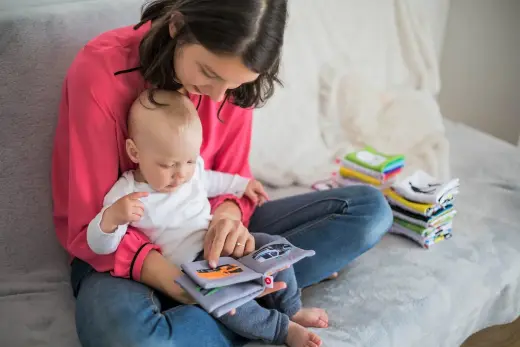
- With books: look at pictures together. Name one picture, make a sound or follow your child's point.
- During songs: pause before a familiar action or word. Give your child time to move, make a sound or join in.
Reading does not require finishing every page. Your toddler may turn pages, point, leave and return. Follow their attention. A few shared minutes can fit into an ordinary day.
Routine words are easier to understand because the same actions happen again. Use simple words for actions your child sees often. Keep the words tied to what is happening. “Wash hands” makes sense while washing hands.
A comparison of ways to support communication
These approaches can work together. None is a treatment plan by itself. A speech and language professional can suggest ideas that suit your child and family.
| Approach | What you do | Example | Keep in mind |
|---|---|---|---|
| Parentese | Use a warm voice and clear, short phrases. | “Look, a bus!” | Use real words. Baby talk is not needed. |
| Wait time | Pause after speaking and watch for a response. | Offer a cup, say “Drink?” and wait. | A response can be a look, point, sound or word. |
| Gestures with words | Point, wave or show while naming the action. | Wave and say “Bye-bye.” | Gestures support communication. They do not need to stop. |
| Follow the child's lead | Talk about what already interests your child. | Your child looks at a bird. You say “Bird flying.” | Share the moment. Avoid turning play into a quiz. |
| Professional assessment | Discuss concerns and ask about checks or support. | Ask your doctor about hearing and speech checks. | Ask when worried. Home practice need not come first. |
When to ask for help
Ask for advice if you are concerned about your child's talking or communication. You do not need to prove a delay before asking. A health professional can hear your concerns and decide what checks may help.
Ask about a hearing check if your child does not respond to sounds or voices as you expect. Hearing can affect how a child learns spoken words. A child may hear some sounds but miss others. A professional can advise whether a hearing check is needed.
Tell the professional if your child has stopped using words, sounds or gestures they used before. Share concerns about understanding, play, interaction or other areas of development. Mention family history of hearing or speech concerns, if relevant.
In Australia, start with your GP, child and family health nurse, or local child health service. Ask about a speech pathologist, who helps with communication, and an audiologist, who checks hearing. Pregnancy, Birth and Baby offers general information and support.
In the UK, speak with your health visitor or GP. Ask about a speech and language therapist and a hearing service. In the US, start with your child's doctor. Ask about a hearing check and speech-language evaluation. In Canada, contact your family doctor, paediatrician or local child development service. Services differ by province and territory.
Some places let families contact speech and language services directly. Others need a referral. Ask what applies where you live. If the first person cannot answer your questions, ask who can help next.
Early support can help a child and family understand what is happening and what to try. It does not mean anyone has failed. You can keep using everyday communication ideas while waiting for an appointment.
What an assessment may involve
A professional will usually ask about your child's health, development, languages, hearing and daily communication. They may ask what your child understands. They may ask how your child expresses needs or shares interest. Your notes can make this talk easier.
A speech and language professional may watch your child play or interact. They may use toys, pictures or familiar routines. The goal is to understand your child's strengths and needs. It is not a pass or fail mark.
A hearing check may be suggested even if your child seems to hear some things. A hearing professional can check how your child responds to different sounds. The right method depends on the child's age and local service.
After the assessment, ask what the findings mean in plain words. Ask what support is available, what you can do at home, and when to review progress. If you are unsure, ask the professional to explain again.
Common mistakes that can add pressure
- Waiting because someone says “boys talk late.” Children differ, but a concern still deserves attention. Ask for advice instead of relying on a general saying.
- Blaming bilingualism. Children can learn more than one language. Keep using the languages your family knows best. Share that information during an assessment.
- Demanding repeated speech. “Say it” can turn a friendly moment into a test. Model the word and accept any attempt.
- Correcting every sound. If your toddler says a word imperfectly, repeat it clearly in your reply. Keep the conversation moving.
- Guessing that hearing is fine. Responding to some sounds does not answer every hearing question. Ask a professional if you are unsure.
- Comparing siblings or cousins. Comparison can raise worry without explaining what your child needs. Focus on your child's skills and changes.
- Using screens as the main way to teach words. A screen cannot take turns like a person. Share play and conversation when you can.
- Trying every online activity at once. Choose a few simple ideas that fit your day. Ask a professional for advice that fits your child.
- Waiting for a perfect word count. Ask for help before you know whether a delay meets a formal definition.
Make a simple communication note
A short note can help you explain your concerns at an appointment. You do not need to track every sound all day. Write down examples that show how your child communicates.
- Words or signs your child uses with meaning, in every language.
- How your child asks for something or gets your attention.
- How your child shows you something interesting.
- Directions or familiar phrases your child seems to understand.
- Sounds or voices your child responds to, and when they do not.
- Any words, gestures or skills that have stopped.
- Questions you want answered at the appointment.
Bring the note if it helps. A short video of a usual interaction may also help, if the professional asks for one and you can record it safely. Do not delay seeking advice while collecting examples.
Official guidance in Australia, the UK, the US and Canada
Families can start with different services. The first step is similar: raise concerns with a child health professional. Ask what checks or support are available. The bodies and services below offer family health information.
| Country | Relevant body or service | How families can start |
|---|---|---|
| Australia | Pregnancy, Birth and Baby; state and territory child health services. | Speak with a GP or child and family health nurse. Ask about hearing and speech checks. |
| United Kingdom | NHS; local speech and language therapy services. | Contact a health visitor or GP. Ask about speech and hearing checks. |
| United States | American Academy of Pediatrics (AAP); local early intervention services. | Talk with your child's doctor. Ask about an evaluation and local support. |
| Canada | Canadian Paediatric Society; provincial and territorial child development services. | Contact your family doctor or paediatrician. Ask which local service checks speech and hearing. |
Names, rules and waiting times vary within each country. A local health professional can explain services in your area. If you need an interpreter, ask whether one is available.
Frequently asked questions
Should I wait until my toddler turns two?
No. If you are worried, ask for advice now. A professional can help decide whether a check is needed. You do not need to wait for a birthday or for your child to fall behind in every area.
Does pointing count as communication?
Yes. Pointing is one way a toddler can share interest or ask for something. Notice what your child points to and respond with words. Tell a professional about gestures as well as spoken words.
Will using two languages confuse my child?
Keep speaking your family languages. Count words across the languages your child uses. Share which languages your child hears and uses during an assessment.
Should I correct my toddler's pronunciation?
You can model the word clearly without asking your child to repeat it. If they say “ba” for “ball,” you might reply, “Yes, ball.” Keep your tone warm and the conversation easy.
What if my toddler understands but says very little?
Tell a health professional what your toddler understands and says. Both are useful details. Ask whether a hearing check or speech and language assessment would help.
Can television or an app teach my toddler to talk?
A screen may show words. It cannot respond to your toddler's own look, sound or gesture like a person can. Shared play and conversation give you chances to take turns. Ask a health professional if screen use worries you.
What if relatives say my child will catch up?
Some children make quick progress. A family saying cannot show what your child needs. You can ask for advice and keep supporting communication at home.
What should I bring to an appointment?
Bring notes about words, signs, understanding, hearing and changes over time. Mention every language your child hears or uses. Write down your questions so you remember them.
Sources and further help
- Pregnancy, Birth and Baby (Australia)
- Raising Children Network – Screen time: babies and toddlers
- NHS Bedfordshire and Luton Children's Health – Screen time
- American Academy of Pediatrics – Safety for your child: 2 to 4 years
- Canadian Paediatric Society – Healthy sleep for your baby and child
Disclaimer: This article gives general information. It is not a diagnosis or a substitute for care from a qualified health professional. If you are worried about your child's development, speak with a health professional. Affiliate disclosure: BabyGearFinder may earn a commission from qualifying purchases. This article contains no product recommendations.
Sources
- Pregnancy, Birth and Baby (Australia)
- Raising Children Network – Screen time: babies and toddlers
- NHS (Bedfordshire and Luton Children's Health) – Screen time
- AAP HealthyChildren.org – Safety for your child: 2 to 4 years
- Caring for Kids (Canadian Paediatric Society) – Healthy sleep for your baby and child
Related guides
More Parental Tips →
Preparing Your Toddler for a New Baby: Simple Ways to Help

Separation Anxiety at Daycare Drop-Off: Simple Ways to Help Your Child Settle
Preparing Your Toddler for a New Baby: Simple Ways to Help Them Adjust
