








Newborn Baby Mittens: When They Help and How to Use Them Safely
Learn when newborn mittens may help, how to choose a safe fit, and when to leave hands uncovered for feeding, comfort and early development.
On this page
- What newborn mittens do
- Do newborns need mittens?
- When mittens may be useful
- Choosing mittens: fit, fabric and fastenings
- How to use mittens during the day
- Mittens and sleep
- Mittens, socks and sleeves compared
- Age and changing needs
- Keeping hands warm without overheating
- Cleaning and checking mittens
- Common mistakes to avoid
- Official guidance in four countries
- When to ask for help
- Frequently asked questions
- Sources and further guidance
- Sources
Short answer: Newborn mittens are optional. They may help keep a baby’s hands warm or reduce scratches for a short time. They are not needed all day. Check your baby’s hands often. Take mittens off if they feel damp, cold, tight or irritating. Keep them off during sleep if they could come loose or cover the face. Ask a midwife, doctor or nurse if your baby scratches often or has a skin problem.
Babies need their hands for touch, movement and comfort. Their hands may also help them find their mouth. That is part of normal early learning. Mittens should not get in the way of these things.
What newborn mittens do
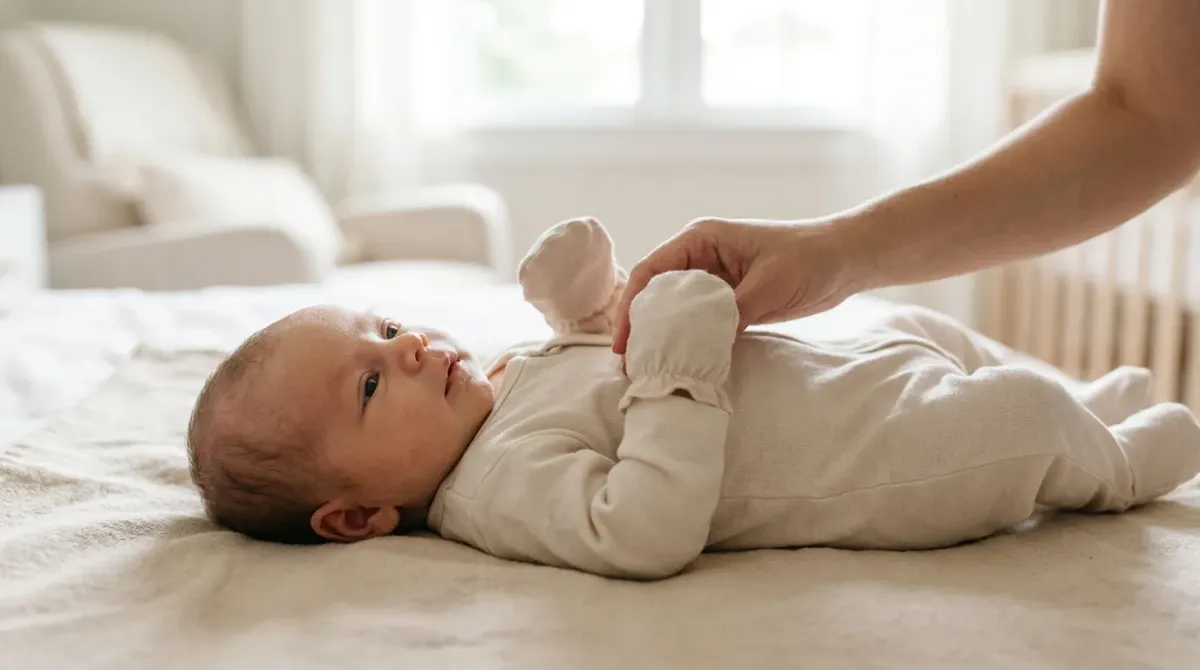
Newborn mittens are small coverings for a baby’s hands. They are usually made from soft fabric. Some have a loose cuff. Others have a fold-over end that covers the fingers.
People often use them for two reasons. They may help warm hands in a cool place. They may also reduce contact between a baby’s nails and face.
Mittens do not treat a skin problem. They do not prevent infection. They cannot stop every scratch. They can also hide the hands, so a caregiver may miss signs of discomfort or a poor fit.
There is no need to buy mittens before your baby arrives. A few pairs may be useful if your baby’s hands seem cold, or if scratching is a concern. You can decide after seeing what your baby needs.
Do newborns need mittens?
Most babies do not need to wear mittens all the time. A comfortable room and suitable clothing may be enough. For warmth, a layer with sleeves can cover the hands without a separate item. Take care that sleeves do not cover the face.
A baby’s hands can feel cooler than their body. That alone does not always mean the baby is cold. Check the chest or back of the neck. If those areas feel comfortably warm, your baby may be warm enough. If they feel hot or sweaty, remove a layer and check again.
Do not use mittens to make a baby sleep longer or to stop normal hand movements. A baby may bring hands to the mouth, touch their face, or curl their fingers. These movements are common. Keep the hands free when practical, especially while your baby is awake and supervised.
Caregivers may have different views about mittens. One person may want them on all day. Another may prefer bare hands. Agree on a simple plan. Use mittens for a clear reason, check the fit, and remove them when that reason has passed.
When mittens may be useful
Mittens may help for a short time in a cool room or outdoors in cool weather. Dress your baby for the conditions. Check their body, not only their hands. Remove extra layers if the baby becomes warm or sweaty.
Some newborns have long or sharp nails. If a baby scratches their face, try gentle nail care first. A caregiver can smooth sharp edges with a baby nail file. Ask a health professional to show you how to trim nails if you feel unsure. Do not bite a baby’s nails. Your mouth can cause small cuts or pass germs.
If you use mittens to reduce scratching, take them off often. Check the skin and nails. Keep the mittens clean and dry. Stop using them if the skin becomes red, damp or sore.
A baby with a skin condition may need care from a health professional. Mittens do not replace that care. Do not cover a rash or wound without advice. Some creams may need to stay uncovered, and some skin problems need treatment.
Mittens can also be handy for a brief walk in cool air. They are not a replacement for a warm outfit suited to the weather. Check your baby during the outing. If the mittens become wet, remove them and use a dry pair. Keep your baby’s face clear and easy to see.
Choosing mittens: fit, fabric and fastenings
Choose a pair that fits your baby’s hand without squeezing it. The fingers should have room to move. The cuff should stay in place without leaving a deep mark. Check the fit again as your baby grows.
- Look for soft fabric. Choose fabric that feels smooth against the skin. Avoid rough seams or scratchy labels.
- Check the cuff. It should stay on without being tight. Avoid tight elastic that leaves a mark.
- Skip loose parts. Do not use mittens with beads, buttons, bows or long ties.
- Check the seams. Look for loose threads, holes and rough edges before each use.
- Choose washable pairs. Follow the care label. Wash dirty mittens before using them again.
- Keep a spare pair. A clean, dry pair can help if one becomes wet or soiled.
Newborn hands grow quickly. A pair that fitted last week may now feel tight. Check the fingers and cuff each time you put mittens on. Do not stretch a tight cuff or cut it to make it fit.
There is no need to choose fabric because of a claim such as “medical grade” or “safety certified.” For ordinary mittens, a plain, well-made pair with a good fit is easier to judge. Follow local product recalls if a product has a known safety issue.
Look at the care label before washing. Some fabric may shrink or become rough when washed the wrong way. A clean mitten should be fully dry before it goes back on your baby. Keep detergent and fabric products out of reach. If a new pair has a strong smell, wash it before use.
Colour and decoration do not make mittens safer. Choose a simple design that is easy to inspect and wash. If a seam opens or a thread comes loose, put the mitten aside. Do not leave a loose thread where a baby can pull or mouth it.
How to use mittens during the day
Use mittens only when there is a clear reason. Put them on with clean, dry hands. Check that each finger can move. Make sure the cuff does not press into the wrist.
Check the mittens after feeds, nappy changes and naps. Babies can dribble or bring their hands to their mouths. Damp fabric may irritate the skin. Change wet mittens promptly.
Take mittens off for parts of the day. Let your baby touch safe, clean surfaces while supervised. Watch for cues that your baby is uncomfortable. Fussing can have many causes, so check the fit and temperature as part of a wider check.
Do not attach mittens to clothing with cords, ribbons or clips. A loose cord can wrap around a baby’s neck or body. Do not tie mittens to a cot, pram or car seat.
Wash your hands before helping a baby with sore or broken skin. Check both hands after removing mittens. Look between the fingers and around the wrist. If you see a new mark, let the skin air and see whether it settles. Ask for health advice if it does not improve.
When you are out, carry a clean spare pair if you expect to need mittens. Keep used pairs separate from clean clothes. A small washable bag can help. Do not put a wet mitten back on just because you are away from home.
Mittens and sleep
Safe sleep advice focuses on a clear sleep space, a firm flat surface, and placing babies on their backs. Mittens are not a safe-sleep tool. They do not lower the risk of sudden infant death.
For sleep, choose clothing that fits well and suits the room. Keep your baby’s head uncovered. Avoid clothing that can come loose or cover the face. If mittens can slip off, remove them before sleep. Do not attach them to the sleep space.
If you use a sleep bag, follow its size and clothing guidance. Do not add loose blankets over your baby. If your baby seems too warm, remove a layer. A baby who is sweating or feels hot at the chest may need less clothing.
Check current safe-sleep advice where you live. Australia’s Red Nose, the UK’s Lullaby Trust, the American Academy of Pediatrics in the US, and the Canadian Paediatric Society all give infant sleep guidance. The details can differ. Follow the advice from your local health service.
Do not put mittens over a baby’s hands to stop them from waking or moving. A baby’s hands may touch their face or mouth during sleep. That movement is not a reason to tie, pin or secure the hands. Keep sleep clothing simple and check that nothing can come loose.
Mittens, socks and sleeves compared
These choices can all cover a baby’s hands. The best choice depends on fit, weather and what your baby needs. None should be tight or attached with a cord.
| Choice | May suit | Check | Limit |
|---|---|---|---|
| Newborn mittens | Short periods when hands need covering | Loose threads, fit, dampness and cuff marks | Can slip off or hide the hands |
| Fold-over sleeves | Keeping hands covered as part of an outfit | Sleeves stay clear of the face | May make it harder to feel and use the hands |
| Baby socks over hands | A temporary spare when no mittens are available | They fit loosely and have no loose parts | May fall off or fit poorly |
| No hand covering | Most awake, supervised time indoors | Room and clothing keep baby comfortable | Hands may feel cool or touch the face |
Do not use socks that are too small. Do not use adult gloves. Their shape and fit may not suit a newborn’s hand.
For most families, the simplest choice is the one that stays dry, fits gently and can be checked easily. You do not need every type. If sleeves are enough, use them. If your baby is comfortable with bare hands, that is fine too.
Age and changing needs
There is no set age when every baby should stop using mittens. Watch your baby’s needs and movement. A newborn may have little control over their hands. Over time, babies often reach, touch and bring their hands to their mouths more.
During the first weeks, you can use mittens briefly if they help with warmth or scratches. Check the fit each time. Take them off during awake time when they are not needed.
As your baby becomes more alert, leave the hands free more often. Your baby can explore safe textures and practise hand movements. Stay close and keep small objects away. Babies learn by touching, but small items can be choking risks.
As your baby grows, stop using any pair that is tight or too small. There is no need to move to larger mittens unless a clear need remains. Sleeves or suitable room temperature may be enough.
Premature babies or babies with health needs may have different care plans. Ask the care team before changing clothing or covering the hands for long periods. Follow the advice that fits your baby’s health and growth.
At every stage, check the baby rather than following a fixed timetable. A baby may stop needing mittens after a few days. Another may need them briefly in cold weather. There is no milestone that every family must reach.
Keeping hands warm without overheating
It can be hard to judge a newborn’s temperature. Hands and feet often feel cooler than the chest. Use the chest or back of the neck as a better check. Your baby should feel comfortably warm, not hot or sweaty.
Use clothing layers that are easy to add or remove. A long-sleeved layer may cover the hands for a short time. In warmer weather, a baby may need fewer layers. Keep the head uncovered indoors and during sleep.
Do not use mittens as a reason to add extra blankets. Loose bedding can cover a baby’s face. Follow safe-sleep advice for your country. If you are unsure about room temperature or clothing, ask your midwife or child health nurse.
In cold weather, plan for the whole body. Use suitable clothing and keep the face visible. Remove extra layers when you go into a warm building or car. Check your baby often, especially if they are bundled in a pram.
Cleaning and checking mittens
Follow the washing instructions on the label. Use a wash routine that suits the fabric and your household. Make sure mittens dry fully before use. Damp fabric can feel cold and irritate skin.
Check the pair before each use. Put it aside if you find a hole, loose thread, damaged seam or stretched cuff. Loose threads can catch on fingers. Do not repair a mitten with a long thread or a small part that could come loose.
Do not share used mittens between babies without washing them. If your baby has a skin condition, ask a health professional whether special washing steps are needed.
Keep clean mittens in a dry place. Do not store them in a damp nappy bag for long periods. If they smell musty or remain damp, wash and dry them fully before use. Throw away a pair that stays damaged after washing.
There is no need for harsh cleaning products for ordinary mittens. Follow the garment label and your health professional’s advice if your baby has a known sensitivity. Rinse well if the care label calls for it.
Common mistakes to avoid
- Leaving mittens on all day. Babies benefit from time with their hands free. Use them only when needed.
- Using mittens as the only warmth check. Feel the chest or back of the neck. Hands can feel cool even when the body is comfortable.
- Choosing a tight cuff. A deep mark or swelling means the fit is wrong. Remove the mitten.
- Ignoring wet fabric. Change damp mittens and check the skin.
- Using mittens to treat a rash. A rash may need different care. Ask a health professional if it persists or worsens.
- Leaving them on during sleep without checking. Anything that can come loose may reach the face. Follow local safe-sleep guidance.
- Attaching them with strings. Cords can create a strangling risk. Keep cords away from babies.
- Trusting broad safety claims. No mitten prevents injury in every case. Check the item yourself and use it with supervision.
- Buying many pairs before birth. You may find your baby does not need them. Start with a small number if you want them.
- Using a pair with loose threads. A damaged mitten can catch on fingers. Put it aside.
- Assuming cold hands mean a cold baby. Check the chest or back of the neck before adding layers.
Official guidance in four countries
Ordinary baby mittens do not have one shared international safety rule in the source guidance listed here. Product rules can change. Check current local advice and recall notices when buying baby items.
| Country | Relevant bodies | Practical guidance |
|---|---|---|
| Australia | Product Safety Australia (ACCC), Red Nose, Pregnancy, Birth and Baby | Check product safety alerts. Follow Red Nose safe-sleep advice. Ask Pregnancy, Birth and Baby or your care team about newborn care. |
| United Kingdom | Office for Product Safety and Standards (OPSS), NHS, The Lullaby Trust | Check product safety information. Follow NHS care advice and Lullaby Trust guidance for sleep and clothing. |
| United States | Consumer Product Safety Commission (CPSC), American Academy of Pediatrics (AAP) | Check CPSC recalls. Use AAP guidance for safe sleep and newborn care. |
| Canada | Health Canada, Canadian Paediatric Society | Check Health Canada recalls and safety alerts. Ask a health professional or consult the Canadian Paediatric Society for infant care. |
These bodies do not say every baby needs mittens. Their broader advice supports safe clothing, close checks and safe sleep. If your baby was born early or has a health condition, ask their care team for advice that fits your baby.
For Australia, Product Safety Australia shares product alerts and recall information. Red Nose provides safe-sleep advice. Pregnancy, Birth and Baby offers government-backed information for families.
In the UK, the Office for Product Safety and Standards handles product safety work. The NHS gives health advice. The Lullaby Trust focuses on safer sleep. In the US, CPSC shares product recalls, while the AAP gives child health advice. In Canada, Health Canada shares recall information, and the Canadian Paediatric Society offers health guidance.
These sources help with wider baby safety. They do not set a special need for ordinary mittens. If you have a concern about fit, temperature or skin, ask a local health professional.
When to ask for help
Talk with a midwife, doctor, nurse or child health service if your baby has repeated scratches, a rash that does not improve, broken skin, swelling or signs of infection. Seek prompt care for a wound that is deep or bleeding heavily.
Ask for help if your baby’s hands seem unusually cold along with other signs of illness, poor feeding or unusual sleepiness. Mittens will not treat the cause. A health professional can check your baby.
If the mittens leave marks, feel tight, or seem to upset your baby, take them off. If your baby has a known skin allergy, ask which fabrics and washing products may suit them.
Get advice if you are unsure how to trim your baby’s nails. A nurse or doctor can show you a safe way. If a scratch becomes red, warm, swollen or wet, contact a health professional.
Frequently asked questions
Are newborn mittens essential?
No. Most babies do not need mittens all day. They may help briefly with warmth or scratching. Check your baby’s comfort and remove them when they are not needed.
Can I leave mittens on my baby overnight?
Follow local safe-sleep guidance. If mittens can come loose, remove them before sleep. Keep the sleep space clear, and keep your baby’s head uncovered.
Do mittens stop babies from scratching?
They may reduce contact between nails and skin for a short time. They cannot prevent every scratch. Keep nails smooth and check the skin often.
How do I know if mittens are too tight?
Remove them if the cuff leaves a deep mark, the fingers look swollen, or your baby seems uncomfortable. A mitten should not squeeze the hand or wrist.
Can I use socks instead of mittens?
A clean, loose-fitting baby sock may cover a hand briefly. Check that it stays on without squeezing. Do not use a small sock or attach it with a cord.
Should my baby wear mittens in warm weather?
Usually, there is no need if your baby is comfortable. Check the chest or back of the neck. Remove extra layers if the baby feels hot or sweaty.
What if my baby keeps removing the mittens?
That may mean the fit is loose, or your baby does not need them. Check the cuff and take them off if they keep slipping. Do not tie them on.
Can mittens help a baby with a rash?
Mittens do not treat a rash. They may hold moisture against the skin. Ask a health professional if the rash is sore, spreading or not improving.
When should I stop using newborn mittens?
Stop when they no longer fit, your baby does not need them, or they get in the way of hand movement. There is no fixed age for every baby.
How many pairs should I buy?
You may not need any. If you want some, start with a small number. See how often they are useful before buying more.
Can I use mittens to keep my baby warm outside?
They can cover the hands briefly in cool weather. Dress your baby for the full conditions and check their body. Keep the face clear and remove wet mittens.
Can I sew a loose mitten back together?
Do not use it if a repair leaves loose threads or small parts. Replace a damaged pair with one that is easy to inspect and wash.
Sources and further guidance
- Pregnancy, Birth and Baby – Preparing your home for when your baby arrives
- The Lullaby Trust – How to dress your baby for sleep
- UK Office for Product Safety and Standards
- American Academy of Pediatrics – A parent's guide to safe sleep
- Health Canada – Recalls and safety alerts
- Red Nose Australia – What is a safe sleeping environment
Disclaimer: This article provides general information, not medical advice. Follow guidance from your child’s health professional. BabyGearFinder may earn a commission from qualifying purchases. This does not affect our content.
Sources
Related guides
More Clothing & Accessories →
Newborn Hats: When a Baby Needs One and How to Choose

How to Use a Baby Wrap Carrier Safely

Digital Parenting Apps: How to Choose and Use Them Alongside Baby Gear
