














Woven Moses Baskets: Palm Leaf, Seagrass, Liners and Safe Use
Compare palm leaf and seagrass Moses baskets, check the mattress and stand, and learn when to stop using a basket for safer baby sleep.
On this page
- What a Moses basket is
- Palm leaf and seagrass: what can you compare?
- Check the mattress and liner
- Choosing a basket and stand
- Weight limits and when to stop
- Safe sleep at every age
- Official guidance in Australia, the UK, the US and Canada
- Buying second-hand or inheriting a basket
- Cleaning and caring for a woven basket
- Common mistakes to avoid
- Frequently asked questions
- Sources and further guidance
- Sources
Short answer: Palm leaf and seagrass are woven materials. The material alone cannot show whether a basket is safe for sleep. Check the whole product, its mattress, and any stand. Follow the maker’s instructions and limits. Put your baby on their back, on a firm, flat mattress, with their face clear. Stop using the basket when your baby reaches its stated limit. Stop sooner if your baby shows signs of rolling, pushing up, or sitting. If instructions are missing, do not use it for sleep.
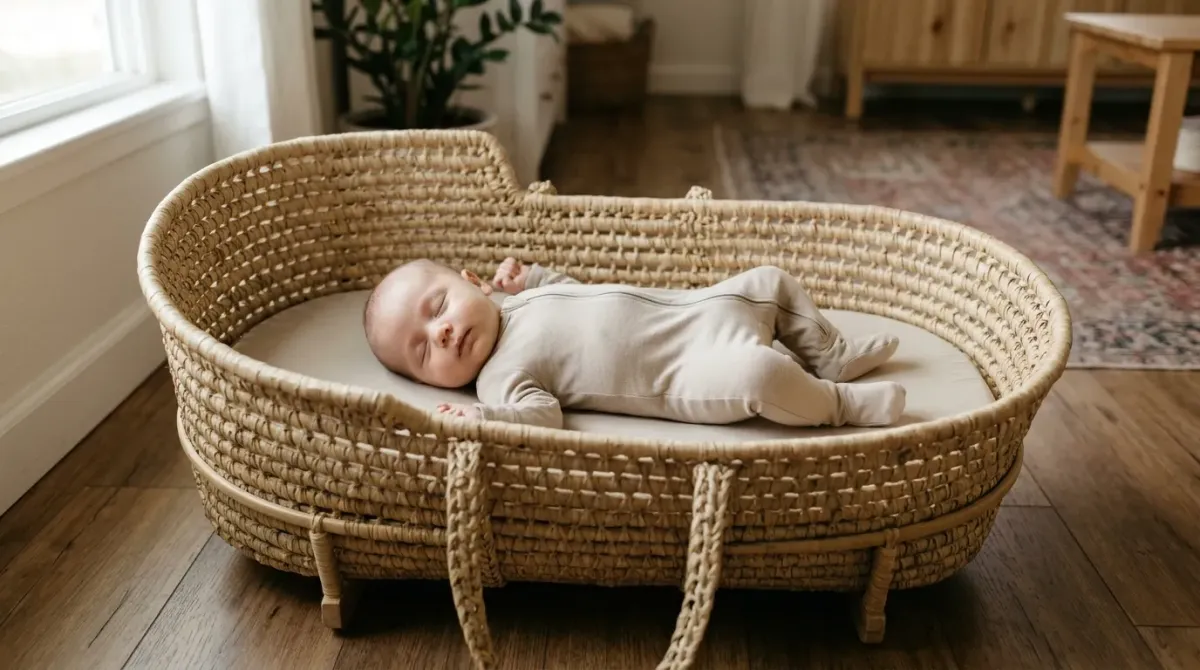
A Moses basket is a small sleep space for a young baby. It can be useful near a caregiver during the early months. It is not a cot. Babies grow and gain new movement skills quickly. The safe period for a basket can be short.
What a Moses basket is
A Moses basket usually has a woven body and a separate mattress. Some models have handles for carrying. Some sit on the floor. Others are sold with a rocking or fixed stand.
The name “Moses basket” does not tell you how the product was tested. It does not tell you which rules it meets. Designs differ. The label and instructions for the exact model matter most.
A basket is meant for sleep only if its maker clearly says so. The maker must also give instructions for safe use. A decorative basket, a doll basket, or a basket without a suitable mattress is not a baby bed.
Palm leaf and seagrass: what can you compare?
Palm leaf and seagrass can both be woven into basket bodies. The feel, shape, finish, and strength depend on the maker. They also depend on how the basket was made. A material name does not prove that one basket is safer, cooler, stronger, or more breathable than another.
Look at the full product rather than the plant material. Check the weave, base, handles, mattress, stand, label, and instructions. Check the basket again before each use. Natural fibres can wear, break, or change shape. A basket that looked sound when bought may later have damage.
| What to check | Palm leaf basket | Seagrass basket |
|---|---|---|
| Woven body | Look for an even weave, no loose strands, and no sharp edges. | Look for an even weave, no loose strands, and no sharp edges. |
| Smell and finish | Check for a strong smell, flaking finish, or damp patches. | Check for a strong smell, flaking finish, or damp patches. |
| Mattress fit | The supplied mattress should lie flat and fit as the maker describes. | The supplied mattress should lie flat and fit as the maker describes. |
| Wear over time | Check for cracks, broken strands, loose handles, or a changed shape. | Check for cracks, broken strands, loose handles, or a changed shape. |
| Safe sleep | Depends on the full product, instructions, and condition. | Depends on the full product, instructions, and condition. |
Do not choose by claims that the weave lets a baby “breathe” or prevents overheating. A woven wall does not replace a clear sleep space, suitable clothing, or care with room temperature. Your baby’s nose and mouth must stay clear. Never cover the basket with a cloth to make it darker or warmer.
Check the mattress and liner
The mattress needs to be firm, flat, and made for that exact basket. It should not sag or slope. It should not leave a gap around the edge. A soft or ill-fitting mattress can let a baby’s face press into a surface. A gap can also trap a baby.
Use only the mattress supplied or named by the maker for that model. Do not add a spare mattress, folded towel, pillow, quilt, foam pad, or extra layer. These can make the surface soft or uneven.
A liner is a fabric cover inside the basket. If the product came with one, fit it only as its instructions show. It should lie flat and stay in place. Do not add a padded liner, bumper, head support, or extra bedding. If fabric is loose, torn, or bunched, stop using the basket until you can follow the maker’s repair or replacement advice. Loose fabric must never be able to cover your baby’s face.
Keep the sleep space clear. Do not put toys, loose blankets, pillows, or quilts beside your baby. Dress your baby for the room. Use a suitable wearable sleep bag if needed. Follow local safe sleep advice about clothing and room temperature.
Do not use a soft mattress because it seems more comfortable. Babies need a firm, flat sleep surface. Do not add a topper to make a hard mattress feel softer. Do not fold or bend the mattress to make it fit. If it does not fit, ask the maker about the correct part.
Choosing a basket and stand
Before buying, find the exact product name, maker, model, and instructions. Ask the seller for the manual if it is missing. Check official recall notices in your country. A basket without clear instructions or a traceable maker is hard to assess.
- Check the sleep claim. The maker should say whether the basket is meant for infant sleep.
- Check the mattress. Confirm that it is the right one for the basket. Ask how to replace it if needed.
- Check the limits. Find the maximum weight. Find any movement signs that mean you must stop using it.
- Check the handles. They should be sound and attached as designed. Follow instructions about folding or removing them.
- Check the stand. It should be the exact compatible stand. Assemble it as directed and place it on a level floor.
- Check the rocking feature. Use it only as the maker allows. Lock it for sleep if the instructions say to do so.
- Check the room. Keep it away from stairs, heaters, cords, curtains, pets, and furniture your baby could reach.
A stand can add risks. It can tip, rock unexpectedly, or move if a child or pet bumps it. Do not place it on a table, bed, sofa, or raised surface. Do not make a stand with blocks or other furniture. A stand should not wobble. If a part is missing or bent, stop using it.
Check that the basket sits properly on the stand. Follow the maker’s method for attaching it. Do not tie it on with extra cords or straps. Do not use a stand made for another model unless the basket maker confirms that it fits.
Weight limits and when to stop
There is no single weight limit for all Moses baskets. Product designs and instructions vary. Do not assume that a commonly quoted number applies to your basket. Check the label and manual for the exact model.
Stop using the basket when your baby reaches the stated weight limit. Stop sooner if the maker lists movement signs, such as rolling, pushing up on hands and knees, sitting, or pulling up. A baby may become too active for the basket before reaching its weight limit.
Do not keep using it because your baby still looks small or seems comfortable. Do not use a basket with missing limits or unclear sleep instructions. Move to a cot or another sleep space that meets the rules where you live.
Check the basket’s size as your baby grows. Your baby should not be cramped against the sides. Do not judge safety by appearance alone. Follow the product’s stated limits and stop signs.
Safe sleep at every age
For every sleep, place your baby on their back. Use a firm, flat surface made for infant sleep. Keep their face and head uncovered. Keep the basket in the same room as the caregiver when possible. Follow local health advice.
Never use a Moses basket on a sofa, armchair, adult bed, or other soft surface. Never leave a baby unattended on a raised surface. If you carry the basket, follow the maker’s carrying instructions. Never carry it with your baby inside unless the instructions clearly allow that use.
If your baby falls asleep in a car seat, stroller, or other sitting device, follow health guidance. Move them to a suitable flat sleep surface as soon as practical. A basket does not make an unsafe sleep location safe.
Do not use the basket for play or storage while your baby is inside. Keep other children from climbing on the stand or rocking it. Keep pets away from the sleep space. An adult should supervise the baby when awake, and the sleep space should still follow safe sleep advice.
A basket should not be used as a place for routine naps if its maker does not describe it as a sleep product. A shop listing or social media post is not enough to confirm how it should be used. Ask the maker if the intended use is unclear.
Official guidance in Australia, the UK, the US and Canada
Official advice differs in detail, but the shared message is clear. Use a sleep space made for babies. Follow its instructions. Keep the sleep surface clear and firm.
| Country | Official bodies | What families can check |
|---|---|---|
| Australia | Product Safety Australia (ACCC) and Red Nose Australia | Check product type, recalls, instructions, mattress fit, and safe sleep advice. |
| United Kingdom | Office for Product Safety and Standards and The Lullaby Trust | Check product safety information and use a firm, flat, clear sleep space. |
| United States | U.S. Consumer Product Safety Commission and American Academy of Pediatrics | Check whether the product is covered by infant sleep product rules. Follow safe sleep guidance. |
| Canada | Health Canada and the Canadian Paediatric Society | Check recalls and follow safe sleep advice from national health bodies. |
Rules can depend on how a product is designed and sold. A retailer’s word, such as “bassinet” or “basket”, does not settle its legal category. Ask the maker or your national product safety body if the product status is unclear.
In Australia, Product Safety Australia gives advice about bassinets and cradles. Red Nose gives safe sleep advice. In the UK, the Office for Product Safety and Standards handles product safety information. The Lullaby Trust gives safer sleep guidance for families.
In the US, the Consumer Product Safety Commission gives information about infant sleep products. The American Academy of Pediatrics shares safe sleep advice for families. In Canada, Health Canada handles product safety information and recalls. The Canadian Paediatric Society shares safe sleep advice.
These sources help families ask better questions. They do not confirm that every basket is safe. Check the actual model, its instructions, and its condition. If you cannot confirm these details, choose a sleep product with clear information.
Buying second-hand or inheriting a basket
A used basket may have damage that is hard to see at first. Ask for the exact model and instructions. Check that the mattress is the right one. Find out whether the basket has been recalled. Do not rely only on a seller’s statement that it was barely used.
Look closely at the weave, base, handles, lining, and stand. Check for broken strands, loose fittings, sharp edges, mould, dampness, or a strong smell. Check that the basket has not changed shape. Do not use it if you cannot confirm its condition.
Do not replace a missing mattress with one cut at home. A handmade mattress may leave gaps or sit unevenly. Ask the maker for the correct replacement. If none is available, choose another sleep space.
Do not assume a product is safe because it belonged to a relative. Safety advice and product rules can change. Older products may lack instructions or model details. If the product cannot be identified, do not use it for sleep.
Cleaning and caring for a woven basket
Follow the maker’s cleaning instructions. Do not soak the basket unless the instructions allow it. Water can change some woven materials or make them weak. Let the basket dry fully before use if it becomes damp.
Do not use a damaged basket. Check it regularly for loose strands, cracks, sharp points, or a base that no longer sits flat. Check the handles and stand too. Stop using any part that is damaged.
Keep the basket dry and store it where it will not be crushed. Do not put heavy items on top. Do not store it in a damp area. Check it again before using it after storage.
Common mistakes to avoid
- Choosing by material alone. Palm leaf or seagrass does not prove safe design or safe use.
- Adding soft padding. Extra liners, blankets, or cushions can make the sleep surface unsafe.
- Using a loose mattress. Gaps can create a place for your baby to become trapped.
- Trusting a weight number from a shop page. Use the limit from the exact product instructions.
- Ignoring movement. A rolling or pushing baby may need to move to a cot before reaching the weight limit.
- Rocking during sleep without checking. Follow the stand’s instructions. Use any lock as directed.
- Putting the stand up high. A fall from a table or bed can cause serious harm.
- Buying without a manual. Missing instructions make safe assembly and use hard to confirm.
- Using a damaged basket. Cracked weave, loose handles, or a bent stand can fail during use.
- Adding a cover to the basket. A cover can block air and may fall near your baby’s face.
- Assuming every basket is for sleep. Some are decorative or made for carrying items only.
Frequently asked questions
Is palm leaf safer than seagrass?
There is no basis here for saying one material is safer. Check the whole product, its mattress, its condition, and its instructions. Material alone cannot show safe sleep performance.
Are woven baskets more breathable?
A woven wall may let air pass through its sides. That does not prove the basket prevents overheating or suffocation. Keep your baby’s face clear and follow safe sleep advice.
Can I use a soft liner?
Use only a liner supplied or approved by the maker. It must fit as instructed and stay flat. Do not add padding, bumpers, or loose fabric.
Can my baby sleep in a basket on a rocking stand?
Only if the maker says the basket and stand are meant for that use. Assemble them as directed. Use the rocking feature only as instructed. Keep the stand on a level floor.
What weight limit should I use?
Use the limit printed for the exact model. There is no universal basket limit. Stop earlier if the instructions name movement signs or your baby reaches them.
Can I carry the basket with my baby inside?
Only if the maker’s instructions clearly allow it. Check the handles and carry it as directed. Never assume handles are safe for carrying a baby.
When should I move my baby to a cot?
Move your baby when they reach the product limit or show any stop-use movement signs. Move sooner if the basket is damaged, too small, or has unclear instructions.
Can I buy a second-hand basket?
Only consider one with its exact instructions, mattress, and model details. Check recalls and inspect it closely. Do not use it if parts are missing or damaged.
Can I add a blanket under the mattress?
No. Do not add a blanket or other layer under the mattress. Use only the mattress and parts named by the maker.
Does a stand make the basket safer?
A stand does not make a basket safer by itself. Use only a compatible stand. Assemble it as directed and keep it on a level floor.
Sources and further guidance
- Product Safety Australia: Bassinets and cradles guide
- Red Nose Australia: What is a safe sleeping environment
- The Lullaby Trust: Mattresses and bedding
- UK Office for Product Safety and Standards
- U.S. CPSC: Infant sleep products business guidance
- Canadian Paediatric Society: Safe sleep for babies
- Health Canada: Recalls and safety alerts
Disclaimer: This guide gives general information, not medical or product-specific advice. Follow your product instructions and ask a health professional or product safety body if you are unsure. Some links may be affiliate links. We may earn a commission if you buy through them, at no extra cost to you.
Sources
- Product Safety Australia – Bassinets and cradles guide
- The Lullaby Trust (UK) – Mattresses and bedding
- UK Office for Product Safety and Standards
- CPSC (US) – Infant sleep products business guidance
- Caring for Kids (Canadian Paediatric Society) – Safe sleep for babies
- Health Canada – Recalls and safety alerts
Related guides
More Health & Safety Gear →
Bath Thermometers for Babies: Spout Covers, Floating Sensors, and Safe Water Temperatures
Childproof Outlet Box Covers vs Sliding Outlet Plates: Keeping Nursery Plugs Safe

Baby Sun Hats and Sunglasses: How to Choose Safe UPF 50+ Hats and UV-Blocking Shades
