How to Choose Safe Teething Toys: 5 Types That Help Sore Gums
Compare the 5 main types of teething toys, check AU, UK, US and Canada toy safety rules, and learn how to clean, chill and use teethers safely.
On this page
- Key points
- What teething is and how teething toys help
- The 5 main types of teething toys
- Side-by-side comparison of teething toy types
- How to choose a safe teething toy
- Teething toys by age stage
- Safety rules in Australia, the UK, the US and Canada
- What to avoid: unsafe teething products and habits
- How to clean, store and check teething toys
- Common mistakes parents make with teething toys
- Other safe ways to soothe sore gums
- Frequently asked questions
- Sources
Short answer: A good teething toy is made from one solid piece of food-grade silicone or natural rubber. It has no small parts, no liquid inside, and no cords or beads. Chill it in the fridge, never the freezer. Wash it with warm soapy water every day, and throw it out if it cracks or tears.
Toy safety rules are strict in Australia (ACCC), the UK (OPSS), the US (CPSC) and Canada (Health Canada). Always buy from trusted shops and check the label for your country's toy safety mark.
Key points
- Material: Pick 100% food-grade silicone or natural rubber. Avoid soft PVC plastic, which can contain harmful softeners called phthalates.
- Shape: Choose a single solid piece that is too big to fit inside your baby's whole mouth.
- Cold relief: Put the teether in the fridge for a short time. Never freeze it rock-hard.
- No cords: Never tie a teething toy around your baby's neck, wrist or cot bars.
- No amber beads: Health groups in all four countries warn against teething necklaces and bracelets.
- Daily checks: Pull and twist the toy before each use. Throw it away if you see bite marks, cracks or sticky spots.
What teething is and how teething toys help
Teething happens when your baby's first teeth push up through the gums. Most babies get their first tooth at around 6 months. Some start at 4 months, and some wait until 10 months or later. Every baby follows their own clock.
As a tooth moves up, the gum can look red and feel swollen. Your baby may drool more than usual. They may rub their cheeks, pull their ears, or chew on their fists. Many babies get fussy and wake more at night for a few days.
What teething does not cause
Teething can make a baby cranky, but it does not make them sick. Health bodies in Australia (healthdirect), the UK (NHS), the US (American Academy of Pediatrics) and Canada (Canadian Paediatric Society) agree on this. Teething does not cause a high fever, vomiting, diarrhoea or a bad cough. If your baby has those signs, call a doctor or nurse. Do not blame it on teeth.
Why chewing helps sore gums
Gentle pressure on sore gums feels good to a teething baby. When your baby bites down on a firm, bouncy toy, it pushes back against the swollen gum. This counter-pressure eases the ache for a while. It also keeps your baby's hands and mind busy.
A clean teething toy is much safer than household items. Babies will chew on keys, phone cases, remote controls or sofa cushions if nothing else is nearby. Those things carry germs, sharp edges, loose buttons or hidden batteries. A proper teether gives your baby a safe, clean place to bite.
The 5 main types of teething toys
Shops sell hundreds of teething toys, but almost all of them fit into five main types. Each type suits a slightly different age and chewing style. Knowing the five types makes shopping simple.
1. Solid silicone rings and shapes
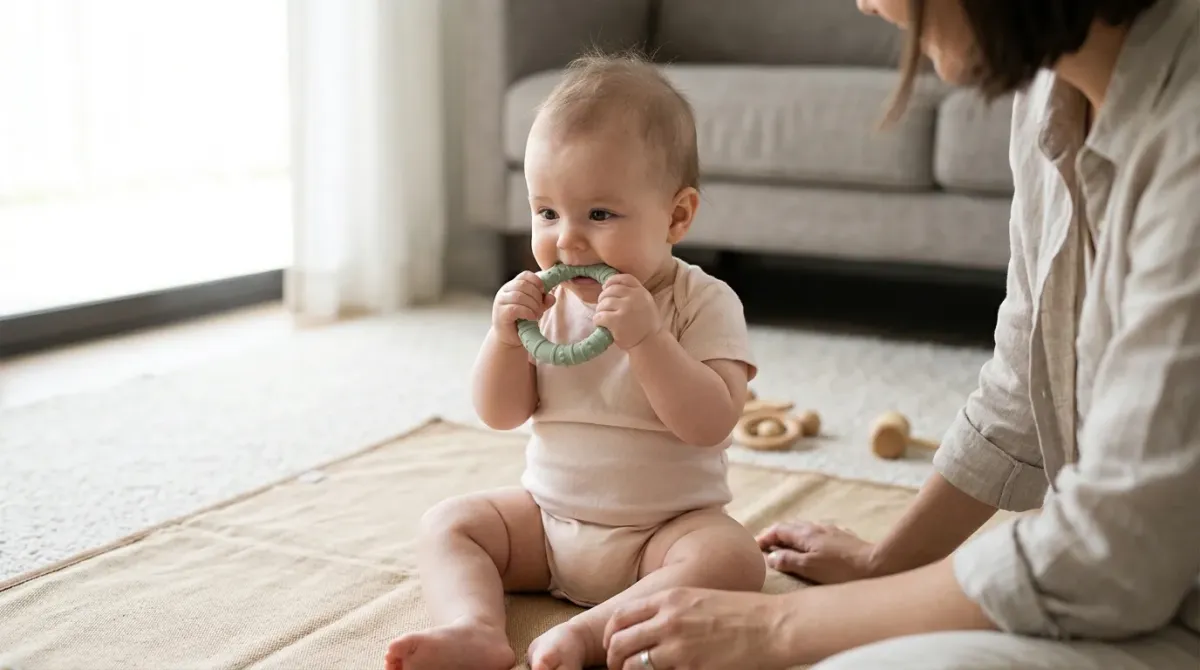
These are the most common teething toys today. They are made from one smooth piece of food-grade silicone. Many look like rings, stars, animals or bumpy keys. They have no seams, glue or paint.
- Why parents like them: They are light, soft on gums and very easy to wash. Most can go in the fridge for extra cooling.
- What to watch for: Make sure the ring is wide enough that it cannot slip down the throat. Check that there are no thin floppy bits your baby could bite off.
2. Natural rubber teethers
Natural rubber teethers come from tree sap (latex). They are soft, slightly matte and have a gentle bounce. Babies often like the warm feel and soft smell of natural rubber.
- Why parents like them: They are plant-based and gentle on tender gums. Many have ridges and bumps that massage the front gums well.
- What to watch for: Do not boil or steam-sterilise most natural rubber toys, as high heat breaks down rubber fast. Also avoid squeaker holes, because water and mould can grow inside. Check for a latex allergy if anyone in your family has one.
3. Fridge-safe cold teethers
Cold numbs sore gums fast. Some teethers are made to hold the chill from your fridge. The safest ones are solid silicone, thick textured plastic, or metal-free gel-free shapes that stay cool for a few minutes. Some older styles are filled with water or gel.
- Why parents like them: Cold pressure calms red, hot gums better than room-temperature toys.
- What to watch for: Skip water-filled or gel-filled teethers if you can. Sharp new teeth can puncture the plastic and leak the liquid inside. Always use the fridge, never the freezer. A frozen toy turns rock-hard and can bruise or frostbite delicate gums.
4. Textured brush and molar teethers
These teethers look like tiny toothbrushes, spoons or long sticks with bumpy tips. They are made for babies who already have front teeth and are growing back teeth (molars).
- Why parents like them: The longer reach helps babies press on the back gums where fingers cannot easily go. Soft silicone bristles also help clean gums and early teeth.
- What to watch for: Long stick-shaped teethers must have a wide guard or shield at the base. Without a wide stop, a baby could poke the back of their throat if they fall while holding it.
5. Silicone teething mitts and wearable teethers
A teething mitt slips over your baby's hand like a soft glove with a bumpy silicone tip. Wrist teethers loop gently around the hand so the baby holds a bar inside.
- Why parents like them: Young babies (3 to 5 months) often drop toys because their grip is still weak. A mitt or wrist-loop stays on the hand while they chew.
- What to watch for: Only use mitts and wrist teethers when you are watching your baby. Take them off before naps or bedtime. Wash fabric mitts often, because wet cloth collects drool and bacteria fast.
Side-by-side comparison of teething toy types
Use this table to compare the five types of teething toys before you buy.
| Type | Best age | Material | Can you chill it? | Easy to clean? | Main watch-out |
|---|---|---|---|---|---|
| Solid silicone rings | 3 to 18 months | Food-grade silicone | Yes, fridge only | Yes, warm soapy water | Avoid thin or small parts |
| Natural rubber teethers | 3 to 15 months | Natural rubber (latex) | Yes, fridge only | Wipe or hand wash only | No boiling; avoid squeaker holes |
| Fridge-safe cold teethers | 4 to 12 months | Solid silicone or safe plastic | Yes, made for fridge | Yes, if one solid piece | Skip liquid-filled rings; never freeze |
| Brush and molar teethers | 6 to 24 months | Food-grade silicone | Yes, fridge only | Yes, rinse bristles well | Must have a wide throat-guard base |
| Teething mitts | 3 to 7 months | Fabric plus silicone tip | No, fabric stays damp | Needs machine or hand wash | Supervise always; remove for sleep |
How to choose a safe teething toy
A teething toy goes straight into your baby's mouth for hours each week. Safety always comes before cute colours or trends. Check these five things on every toy you pick up.
One solid piece is best
Look for a toy made from a single mould. Toys with glued parts, painted faces, bells inside or screw-on caps can break apart. Once a baby gets teeth, their bite is surprisingly strong. A loose cap or bead can block a baby's airway in seconds.
Do the size and shape check
A safe teething toy must be too large to fit all the way inside your baby's mouth. Even better, it should be shaped so no long narrow end can reach the back of the throat. In toy safety testing, inspectors use a small-parts cylinder. At home, a simple rule helps: if any part of the toy—or the whole toy—looks small enough to pass through a toilet roll tube, it is too small for a child under 3 years.
Skip holes and hollow toys
Many rubber animals have a tiny air hole on the bottom so they squeak. When your baby chews on them, drool and bath water get inside. Dark, damp rubber grows mould fast, and you cannot scrub the inside. Always pick solid, sealed toys with no holes.
Check for safe, non-toxic materials
Choose toys clearly labelled as 100% food-grade silicone, natural rubber, or untreated beech or maple wood (sealed with food-safe oil, never paint or varnish). Look for labels that say BPA-free and phthalate-free.
What are BPA and phthalates? BPA (bisphenol A) is an industrial chemical used in some hard plastics. Phthalates are chemicals added to make soft plastics bendy. Both can leach out when chewed. Toy safety laws in Australia, the UK, the US and Canada strictly limit phthalates in toys made for babies to put in their mouths.
Be careful with wooden teethers
Wooden rings look lovely, and solid hardwood does not hold bacteria as easily as soft cloth. Still, wood can splinter if it gets soaked too often or dropped on tiles. Never soak a wooden teether in water or put it in a dishwasher. Wipe it with a damp cloth and let it dry. Check the wood grain for rough spots or cracks before every use.
Teething toys by age stage
Your baby's mouth and hand skills change fast in the first two years. A toy that works at 4 months may not reach the sore spot at 14 months.
3 to 5 months: light and easy to hold
Many babies start drooling and chewing their hands long before the first tooth pops out. At this age, babies cannot hold heavy or awkward toys for long. Pick a very light silicone ring with a thin grip, or a supervised teething mitt. Soft, wide shapes let them practise bringing their hands to their mouth.
6 to 9 months: front teeth arrive
The bottom front teeth usually come through first, followed by the top front teeth. Babies now have a strong grip and love textured bumps. Solid silicone teethers and fridge-chilled rings work well here. You can also offer a clean, damp face washer that has been chilled in the fridge for 15 minutes. Always stay with your baby while they chew a cold cloth.
9 to 15 months: side teeth and strong bites
Once babies have top and bottom front teeth, they can bite much harder. Watch closely for wear and tear on soft rubber toys. A toothbrush-style teether with a wide guard helps reach the side gums. Harder silicone shapes work better than very squishy ones at this stage.
15 to 24 months: back molars
Molars are wide, flat teeth at the back of the mouth. They often hurt more than front teeth because they push through a larger area of gum. Short round rings cannot reach back there. A longer molar teether with a firm, bumpy tip and a wide safety stop lets your toddler press right on the sore back gum.
Safety rules in Australia, the UK, the US and Canada
Toy safety laws are similar across all four countries, though each uses its own national standard and safety body. Buying from a local, reputable store helps ensure the toy meets your country's rules. Cheap unbranded toys bought from random overseas marketplaces sometimes skip these tests.
| Country | Main safety body | Toy safety standard | Key rules for teething toys |
|---|---|---|---|
| Australia | ACCC (Product Safety Australia) | AS/NZS ISO 8124 (and AS/NZS 8124) | Mandatory rules for toys for children under 36 months. Strict limits on small parts and phthalates. |
| UK | Office for Product Safety and Standards (OPSS) | BS EN 71 (or EN 71) | Checks small parts, sharp edges, strength and toxic chemicals. Look for the UKCA or CE mark. |
| US | Consumer Product Safety Commission (CPSC) | ASTM F963 | Mandatory toy standard. Strict federal limits on lead and phthalates in teethers and rattles. |
| Canada | Health Canada | Canadian toy safety laws | Bans small parts on toys for under 3s. Strictly limits lead, phthalates and harmful chemicals. |
Before you buy—or if you receive a second-hand toy—check the recall list in your country:
- Australia: Product Safety Australia recalls page (ACCC).
- UK: GOV.UK Product Safety Alerts and Recalls (OPSS).
- US: CPSC recalls website.
- Canada: Health Canada Recalls and Safety Alerts.
What to avoid: unsafe teething products and habits
Some popular teething items are dangerous, even though shops or social media sellers still advertise them. Health and safety groups in Australia, the UK, the US and Canada warn parents to avoid the items below.
Amber teething necklaces and beaded jewellery
Do not put amber necklaces, silicone bead necklaces or teething bracelets on your baby. There is no proof that amber releases pain relief into the skin. Worse, these items carry two serious risks:
- Strangulation: A necklace can catch on a cot, car seat, highchair or clothing and choke your baby.
- Choking: If the string snaps, your baby can swallow or inhale the loose beads.
The ACCC in Australia, the NHS in the UK, the American Academy of Pediatrics in the US and Health Canada all warn against teething jewellery for babies.
Cords, ribbons and dummy clips
Never tie a teething toy to your baby's clothes, wrist or cot with a ribbon or long string. A cord longer than a few centimetres can wrap around a baby's neck. If you use a dummy clip during awake time, make sure it meets safety rules, has no loose beads, and is always removed before sleep.
Teething gels with unsafe ingredients
Many health groups advise against over-the-counter teething gels and tablets. In the US, the FDA warns against gels with benzocaine, because it can cause a rare but serious blood problem in young children. Homeopathic teething tablets with belladonna have also been recalled in the past. In the UK, the NHS says there is a lack of proof that teething gels work, and advises trying a teether or gentle gum massage first. If you think your baby needs medicine for pain, ask your doctor or pharmacist for the right dose of infant paracetamol or ibuprofen (check age limits first).
Frozen solid objects
Never give your baby a rock-hard frozen teether, an ice cube or frozen chunks of fruit in a loose mesh bag without watching closely. Extreme cold can damage the soft skin inside the mouth. Hard frozen items can also bruise sore gums or chip a new tooth.
Toys with button batteries or magnets
Some novelty baby toys light up or play music. Never give a teething baby a toy with a button battery or loose magnets. Swallowing a button battery can burn through a child's throat or gut in less than two hours. Swallowing two or more magnets can pinch the gut together and cause life-threatening harm. Keep all battery-powered gadgets out of reach.
Mesh feeders with unsafe foods
Silicone or mesh food feeders let older babies suck on soft fruit like mashed banana. Only use them if your baby has already started solid foods (around 6 months) and is sitting upright with you watching. Wash mesh bags very well after every use, as trapped fruit grows mould quickly.
How to clean, store and check teething toys
Teething toys drop on the floor, pick up pet hair and collect drool all day. A simple cleaning routine keeps germs away without wearing out the toy.
Daily washing
- Wash the teething toy in warm water with mild dish soap after each session, or at least once a day.
- Use a clean bottle brush to scrub bumpy ridges and grooves where drool dries.
- Rinse well with clean tap water so no soap taste stays behind.
- Air-dry on a clean rack or paper towel. Do not leave wet toys sealed in a plastic bag.
Can you boil or sterilise teething toys?
Always read the label first. Many 100% silicone teethers can go in the top rack of the dishwasher or be boiled for a few minutes. Natural rubber, gel-filled plastics and wooden toys usually cannot take high heat. Boiling can melt plastic, warp shapes or make rubber sticky and weak. When in doubt, warm soapy water and a good rinse are enough for healthy babies. (If your baby was born early or has a weak immune system, ask your doctor about sterilising.)
How to store cold teethers
If you chill a teether in the fridge, put it inside a clean, sealed food container or zip-top bag. This keeps it away from raw meat, spills and fridge odours. Wash the container often too.
When to throw a teething toy away
Check every teething toy before you hand it over. Give it a firm tug and a twist. Throw it in the bin right away if you notice:
- any crack, split, hole or bite mark;
- bits of rubber or silicone flaking off;
- a sticky, tacky or slimy feel that does not wash off;
- faded or peeling paint;
- dark spots inside a hollow toy (a sign of mould);
- any loose part that wobbles or rattles when it should not.
Common mistakes parents make with teething toys
Even careful parents fall into a few easy traps when they are tired and their baby is crying. Here are the most common mistakes and how to fix them.
- Putting teethers in the freezer: It feels like colder is better, but frozen toys get too hard for tender gums. Keep them in the fridge instead.
- Leaving teethers in the cot: Babies should sleep in a clear cot with no loose toys, pillows or blankets. Take the teething toy out once your baby falls asleep.
- Buying unbranded packs online: Multipacks from unknown sellers may look like famous brands, but they often skip safety testing and may contain banned phthalates or small breakable parts.
- Keeping hand-me-down rubber toys too long: Natural rubber breaks down over time, even in a cupboard. Old rubber turns sticky or brittle and can snap when chewed. Buy fresh teethers for a new baby.
- Giving a teether as a substitute for a check-up: If your baby has a high fever, rash, trouble breathing or refuses all feeds, do not just hand them a teether. Call your doctor or health helpline.
Other safe ways to soothe sore gums
Teething toys are great, but they are not the only tool you have. Sometimes a mix of simple comforts works best.
- Clean finger massage: Wash your hands well with soap and water. Gently rub your baby's sore gum with one clean finger for a minute or two.
- Cool damp cloth: Wet a clean, soft washcloth with drinking water. Chill it in the fridge for 15 minutes. Let your baby chew it while you sit right next to them.
- Extra cuddles and distraction: A walk outside, a warm bath or quiet singing can take your baby's mind off a sore mouth.
- Wipe drool often: Constant drool can cause a red chin rash. Dab your baby's chin gently with a soft cloth and use a plain barrier cream if the skin looks dry.
Frequently asked questions
When should I give my baby a teething toy?
Most babies start enjoying teething toys between 3 and 6 months of age. You do not need to wait for a tooth to break through. If your baby is drooling a lot and trying to chew their hands, you can offer a light, safe teether while watching them.
Can I put a teething toy in the freezer?
No. Never freeze a teething toy solid. A frozen toy turns rock-hard and can bruise your baby's gums or injure the delicate tissue inside their mouth. Put the teething toy in the fridge instead so it is cool and soothing, not icy.
Are silicone or natural rubber teethers better?
Both can be great choices when made to safety standards. Food-grade silicone is easy to wash, handles heat well and lasts a long time. Natural rubber feels softer and warmer, which some babies prefer, though it breaks down faster and cannot be boiled. Avoid natural rubber if your child has a latex allergy.
Are amber teething necklaces safe?
No. Health and product safety bodies in Australia, the UK, the US and Canada warn parents not to use amber teething necklaces or beaded bracelets. They can choke a baby if the string breaks, or strangle a baby if the necklace catches on something. There is also no medical proof that amber eases teething pain.
How often should I wash a teething toy?
Wash a teething toy with warm soapy water at least once a day, and always after it falls on the floor or goes outside. Rinse it well with clean water and let it air-dry completely. Check the care label before putting any teether in a dishwasher or steriliser.
Can my baby sleep with a teething toy in the cot?
No. Safe sleep guidelines in Australia (Red Nose), the UK (Lullaby Trust), the US (AAP) and Canada (Health Canada) all say to keep the cot completely clear. Remove all toys, mitts, clips and loose items before your baby goes to sleep.
When should I throw a teething toy away?
Throw a teething toy away as soon as you see cracks, tears, bite marks, peeling parts, sticky rubber or dark spots inside. Once a baby gets teeth, check soft teethers every day. A damaged toy can break apart and become a choking hazard.
Sources
- Product Safety Australia – Recalls
- Food Standards Australia New Zealand – Bisphenol A (BPA)
- healthdirect – Choking
- UK Office for Product Safety and Standards
- NHS – Baby and toddler safety
- U.S. CPSC – Phthalates business guidance
- American Academy of Pediatrics (US) – Choking prevention
- Health Canada – Recalls and safety alerts
Related guides
More Feeding & Baby Food →
Teething Relief: Safe Ways to Soothe Your Baby's Sore Gums

Baby Teething: Gentle Ways to Soothe Sore Gums and Know When to Get Help
Baby Teething: Safe Ways to Ease Sore Gums