














Baby Hair Ties for Thin Hair: How to Choose Safe, Gentle Ties
How to choose baby hair ties for thin hair: soft materials that do not pull, safe sizes to prevent choking, when to take them out, and what to avoid.

On this page
- Key points
- Why thin baby hair needs gentle ties
- Types of baby hair ties compared
- Safety first: choking, strangulation, and sleep rules
- Materials to look for and materials to avoid
- How to put in and take out baby hair ties without pulling
- Alternatives to hair ties for thin baby hair
- How to store, clean, and replace baby hair ties
- Age-by-age guide: from newborn to toddler
- Safety standards and official advice
- Common mistakes parents make
- Frequently asked questions
- Sources
Short answer: Pick soft, join-free nylon or silk-covered ties with no metal parts, glue, or small beads. Tie them loosely so they never pull on your baby's scalp. Always take hair ties out before naps, bedtime, and car rides, because small ties are a choking hazard.
This safety advice matches guidance from health and product safety groups in Australia (ACCC / Product Safety Australia and healthdirect), the UK (OPSS and the NHS), the US (CPSC and the American Academy of Pediatrics), and Canada (Health Canada).
Key points
- Go soft: join-free nylon bands and silk-covered ties are kindest to fine, thin hair.
- Skip metal and glue: metal clasps snag hair, and glued-on bows can pop off into a baby's mouth.
- Keep it loose: a tight tie can hurt the scalp and cause hair to snap.
- No small parts: babies put everything in their mouths, so avoid tiny rubber bands, beads, and clips.
- Take them out for sleep: never leave any hair tie, clip, or headband on a sleeping baby.
- Check every time: look for frayed elastic or loose stitching before you put a tie in.
Why thin baby hair needs gentle ties
A baby's hair is very different from an adult's hair. Most babies are born with fine, soft strands that break easily. Even when a baby has a full head of hair, each strand is much thinner than adult hair.
Thin hair also slips out of standard hair ties. Parents often wrap a normal tie around three or four times to make it stay. That extra tension pulls on the hair roots. Over time, tight pulling can cause sore spots on the scalp and even patchy hair loss.
A baby's scalp is also very sensitive. Their skin is thin and can get red or irritated quickly. Rough seams, stiff elastic, and metal joins rub against the skin and snag fine strands when you pull the tie out.
Do babies even need hair ties?
Most babies do not need hair ties at all. In the first few months, hair is usually short enough to stay out of the eyes. If hair does fall into your baby's eyes, a soft brush or a gentle side part often works well.
Once hair grows long enough to poke into the eyes or get messy at mealtime, a soft tie or a small fabric headband can help. Even then, keep it simple and only use one when your baby is awake and where you can see them.
Types of baby hair ties compared
Not all hair ties work well for fine baby hair. Some grip without pulling, while others snap strands or slip straight off. Here is how the main types compare.
| Type of hair tie | Grip on thin hair | Gentleness | Safety notes |
|---|---|---|---|
| Join-free nylon bands | Very good | Very gentle, no seam to snag | Small size can be a choking risk if left loose |
| Silk or satin mini scrunchies | Fair, may slip on very fine hair | Very gentle, smooth fabric | Safer size, but check that stitching is strong |
| Cotton-covered elastics | Good | Gentle if join-free | Avoid ones with metal crimps or glued bows |
| Tiny clear or coloured rubber bands | Strong grip | Harsh, often snaps fine hair | High choking risk and hard to remove without cutting |
| Knotted ribbon ties | Good | Gentle | Make sure ends are short so they cannot wrap around fingers |
| Hard plastic or metal clips | Clips can slip on thin hair | Can pinch scalp or pull hair | Small clips and loose parts are a choking hazard |
Join-free nylon bands
Join-free nylon bands feel like soft tights or stockings. They stretch easily and bounce back without a hard ridge. Because there is no seam or metal join, they slide out smoothly at the end of the day.
They hold thin hair well with just one or two loops. The main drawback is their small size. Never leave a loose nylon band on the floor, in a cot, or on your baby's wrist.
Silk and satin mini scrunchies
Silk and satin are smooth, so they create very little friction against fine hair. A mini scrunchie wraps around the hair with soft fabric padding. It looks cute and is easy to spot if it falls out.
On very silky, straight baby hair, a scrunchie can sometimes slide down. Look for a mini size made for toddlers, with a soft inner elastic that holds without needing four twists.
Cotton-covered elastics
Cotton-covered elastics are soft and breathable. They work best when the hair is a little thicker or longer, such as around 12 months and up. Always check how the elastic is joined. Skip any band with a metal clasp or a thick, scratchy glue bump.
Tiny rubber or silicone bands
Many parents buy packs of tiny clear or bright rubber bands. They grip thin hair well, which makes them tempting. However, they are one of the hardest types to take out.
Rubber grips the hair so tightly that pulling it out often rips fine strands. Many parents end up cutting them out with small scissors, which is risky if a baby moves suddenly. Tiny rubber bands are also very easy for a baby to swallow.
Safety first: choking, strangulation, and sleep rules
Safety matters more than style when it comes to baby accessories. Babies explore the world with their hands and mouths. Anything small enough to fit inside a toilet paper roll can block a baby's airway.
Choking hazards
Most baby hair ties are small. If a tie slips out, your baby may pick it up and put it straight into their mouth. Ties with glued-on bows, plastic flowers, pearls, or buttons are even riskier. A baby can bite or pull a decoration off in seconds.
Choose plain, one-piece ties with no extra bits attached. If you want a bow, pick a fabric tie where the bow is sewn into the band with strong thread, and tug on it before every use to make sure it is secure.
Sleep safety
Never put a baby down to sleep with a hair tie, clip, or headband on. This applies to daytime naps as well as overnight sleep.
Health groups in Australia, the UK, the US, and Canada all advise a clear, bare sleep space. Loose items in a cot can end up over a baby's face or in their mouth. A headband can also slip down over the nose and mouth, or press against the neck.
Car seats and prams
Take hair ties and clips out before long car trips if your baby might fall asleep. In a car seat, you cannot see what your baby is doing with their hands while you drive. A loose tie in the back seat is out of reach for you, but right in reach for your baby.
Wristbands and fingers
Some parents slip a spare hair tie onto their baby's wrist so it does not get lost. Do not do this. A tight band on a wrist or finger can cut off blood flow, and a baby can easily chew it off.
Materials to look for and materials to avoid
The fabric and elastic inside a hair tie affect both comfort and safety. Here is what to check on the label.
Best materials for thin baby hair
- Soft nylon: stretchy, smooth, and free of hard seams.
- Mulberry silk or satin: glides over hair without roughing up the strands.
- Organic cotton: soft on sensitive skin and easy to wash.
- Soft jersey knit: gentle and stretchy, often used for baby headbands and knotted ties.
Materials to skip
- Bare rubber or latex: pulls hair, snaps easily, and can cause skin allergies in some children.
- Metal clasps or crimps: catch and tear fine hair.
- Hot-glued decorations: glue can soften in warm weather or with drool, letting small parts fall off.
- Glitter and sequins: rough on the scalp and easy to peel off and swallow.
Also watch out for cheap plastic parts that may contain restricted chemicals like phthalates or lead. Buying from trusted local stores that follow national safety rules helps lower this risk.
How to put in and take out baby hair ties without pulling
Even the softest hair tie can hurt if you put it in or pull it out too fast. A calm, gentle routine keeps your baby happy and protects their hair.
Putting the tie in
- Pick a calm time: style hair after a feed or during quiet play, not when your baby is tired or hungry.
- Use a soft brush: smooth the hair gently with a soft-bristle baby brush first.
- Gather a small section: for thin hair, a tiny top ponytail or two small pigtails hold better than one big bunch.
- Loop loosely: wrap the tie once or twice. It should hold the hair without pulling the skin at the hairline.
- Check the tension: you should be able to slide a finger under the tie easily.
Taking the tie out
- Support the hair: hold the ponytail at the base with one hand so the scalp does not get tugged.
- Slide, do not yank: gently roll or slide the tie down the hair shaft with your other hand.
- Stop if it snags: if a strand wraps around the tie, untangle it with your fingers instead of pulling harder.
- Store it high up: put the tie straight into a high drawer or lidded box out of your baby's reach.
Alternatives to hair ties for thin baby hair
You do not have to use hair ties to keep hair out of your baby's face. Several simple options work well for thin, fine hair.
Soft, wide fabric headbands
A wide, stretchy cotton or jersey headband can keep wispy hair back without pulling on any single spot. Make sure it fits loosely enough that it leaves no red marks on the forehead. Always take it off before sleep or car rides.
Gentle brushing and water
A light mist of water and a soft-bristle baby brush can train fine hair to sit to the side. This works well after a bath when hair is still damp.
A light fringe trim
If hair keeps poking into your baby's eyes, a tiny trim of the front strands is often the easiest fix. Use blunt-nosed baby scissors when your baby is calm, or ask a hairdresser who is used to cutting children's hair.
Sun hats outdoors
Outside, a soft wide-brimmed sun hat keeps hair out of the eyes and protects your baby's face and neck from the sun. Pick one with a soft chin strap that has a quick-release clasp, or no strap at all for very young babies.
How to store, clean, and replace baby hair ties
Hair ties pick up food, drool, and dust quickly. Keeping them clean and in good shape protects your baby's skin and hair.
- Wash them often: hand-wash nylon and fabric ties in warm water with mild baby soap, then rinse well.
- Air dry flat: lay wet ties on a clean towel. Hot dryers can melt or weaken the elastic inside.
- Store out of reach: keep all ties in a closed jar or high drawer. Never leave them on the change table, bedside table, or sofa.
- Throw away worn ties: if a tie is stretched out, frayed, or has loose threads, bin it right away.
Age-by-age guide: from newborn to toddler
Your baby's hair and movement skills change fast in the first three years. What works at 4 months may not work at 18 months.
Newborn to 6 months
Most newborns have very fine, soft hair, or very little hair at all. At this stage, hair ties are rarely needed. Babies spend a lot of time lying on their backs, and any tie or clip at the back of the head will press into their scalp.
If your baby has long hair near their eyes, a soft, wide cotton headband worn only while awake and supervised is usually more comfortable than a tie.
6 to 12 months
Babies start sitting up, crawling, and grabbing everything within reach. If hair falls into their eyes, a single soft nylon band at the top of the head works well. Keep it out of reach of little hands when you take it off, because babies at this age put almost everything in their mouths.
12 to 24 months
Toddler hair often gets thicker, though many toddlers still have fine, wispy strands. Mini scrunchies and soft cotton-covered ties start to hold better now. Toddlers also love to pull their own hair ties out. Check the floor and cot often for dropped ties.
2 to 3 years and up
By age two or three, hair is usually strong enough for fabric-covered elastics, knotted ribbon ties, and larger scrunchies. You can start teaching your child not to put hair ties in their mouth, though supervision is still important.
Safety standards and official advice
Hair ties are usually sold as clothing accessories rather than toys, so they do not always have their own dedicated hair-tie standard. However, national product safety bodies still set rules on small parts, choking hazards, and harmful chemicals in children's products.
| Country | Official bodies | What they focus on |
|---|---|---|
| Australia | ACCC / Product Safety Australia and healthdirect | Small parts rules for under-3s, choking first aid, and product recalls |
| UK | Office for Product Safety and Standards (OPSS), NHS, and RoSPA | Toy and child product safety (including BS EN 71 small parts), choking prevention, and clear cots |
| US | Consumer Product Safety Commission (CPSC) and American Academy of Pediatrics (AAP) | Small parts bans for under-3s (ASTM F963 for toys), phthalate limits, and choking prevention |
| Canada | Health Canada and Canadian Paediatric Society (CPS) | Strict small-parts and chemical rules, product recalls, and safe sleep guidance |
In Australia, toy safety rules such as AS/NZS 8124 (and AS/NZS ISO 8124) test for small parts that could choke a child under 36 months. Similar rules apply in the UK (EN 71 and BS EN 71) and the US (ASTM F963). Even when a hair tie is not sold as a toy, using those same small-parts ideas helps you judge what is safe for your baby.
If you ever buy hair accessories and notice loose parts or a recall, check your national recall list. Product Safety Australia, the UK OPSS, the US CPSC, and Health Canada all publish free recall alerts online.
Common mistakes parents make
It is easy to make small mistakes when you are in a rush. Here are the most common ones to watch out for.
- Using adult hair ties: adult elastics are too thick and heavy for fine baby hair, and they slip right off unless wrapped too tightly.
- Leaving ties in overnight: sleeping in a hair tie can pull the hair, irritate the scalp, and create a choking risk if it comes loose.
- Tying hair while wet: wet hair stretches and snaps much more easily than dry hair. Let hair dry first.
- Putting the tie in the same spot every day: parting and tying hair in the exact same place every day puts stress on the same roots. Move the ponytail slightly from day to day.
- Keeping spares on the wrist: a hair tie on a baby's wrist can pinch the skin or end up in their mouth.
- Buying packs with tiny plastic charms: cute charms are often glued on poorly and are the first thing to break off.
Frequently asked questions
What is the safest hair tie for a baby with thin hair?
A plain, join-free nylon band or a soft silk mini scrunchie is usually the safest choice. Look for one piece of soft fabric with no metal clasp, no glue, and no small charms or beads.
At what age can I start using hair ties on my baby?
There is no set age, but most babies do not need hair ties until their hair is long enough to fall into their eyes. For many babies, that is around 6 to 12 months. Always supervise your baby while they wear one.
Can hair ties damage my baby's hair or cause hair loss?
Yes, if they are too tight or made of rough rubber. Tight pulling stresses the hair roots and can cause breakage or small bald patches. Keep ties loose and use smooth, join-free fabric.
Is it safe for a baby to sleep with a hair tie in?
No. Take out all hair ties, clips, and headbands before every nap and at bedtime. Loose items in a cot are a choking and suffocation risk.
How do I stop hair ties from slipping out of thin baby hair?
Use a smaller section of hair, such as a tiny top-knot, rather than trying to gather all the hair at once. Join-free nylon bands grip fine hair better than smooth satin scrunchies.
How should I wash baby hair ties?
Wash fabric and nylon ties in warm soapy water by hand, or inside a mesh laundry bag on a gentle cycle. Let them air dry flat so the elastic does not stretch out. Throw away any tie that looks frayed or loose.
Sources
Related guides
More Clothing & Accessories →
Soft Nylon Baby Headbands and Non-Pull Hair Ties: Protecting Soft Spots and Fine Hair
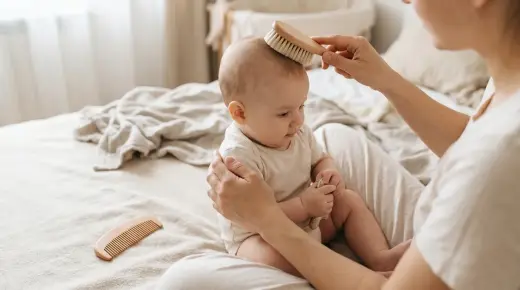
How to Choose and Use a Baby Hair Brush and Comb

Dad's Day Out: How to Choose a Safe, Comfortable Baby Carrier
