












Helping Your Baby Sleep Through the Night: A Simple, Safe Guide
Help your baby sleep longer at night with simple routines, safe cot setup, and age-by-age guidance from AU, UK, US and Canadian health bodies.

On this page
- Key points
- What "sleeping through the night" really means
- How baby sleep changes by age
- Setting up a safe place to sleep
- Building a calm bedtime routine
- Helping your baby learn day from night
- Spotting tired signs before overtiredness hits
- Responsive settling and gentle ways to help your baby sleep
- Safe sleep rules in Australia, the UK, the US and Canada
- Why babies still wake up at night
- Common mistakes that make night sleep harder
- Taking care of yourself when you are exhausted
- When to ask a doctor or nurse for help
- Frequently asked questions
- Sources
Short answer: Most babies do not sleep all night without waking for the first few months. Newborns have tiny tummies and need to feed often, day and night. As your baby grows, you can help them sleep for longer stretches. Use a safe, clear cot on their back, keep nights dark and quiet, and follow a calm bedtime routine.
This guide brings together trusted advice from Australia (Red Nose and Pregnancy, Birth and Baby), the UK (NHS and The Lullaby Trust), the US (American Academy of Pediatrics), and Canada (Canadian Paediatric Society).
Key points
- Waking is normal: Young babies wake often to feed, stay warm, and feel safe.
- Safety first: Always place your baby on their back on a firm, flat mattress in a clear cot.
- Room sharing: Keep your baby's cot in your bedroom for at least the first 6 months.
- Day and night cues: Keep daytime bright and playful. Keep nighttime dark, calm, and boring.
- Simple routines: A short, repeatable bedtime routine helps your baby know sleep is coming.
- Every baby is different: Some babies sleep longer stretches early. Others take a year or more.
What "sleeping through the night" really means
Many new parents hope their baby will sleep for ten hours straight. In real life, "sleeping through the night" means something much shorter for a baby. Health groups often describe it as sleeping for five or six hours in a row without waking you.
Even adults wake up briefly during the night. We turn over, check our blanket, and go right back to sleep. Babies do the same thing. Their sleep cycles are shorter than adult cycles.
At the end of a sleep cycle, a baby stirs. If they are hungry, cold, or wet, they will cry out. If they feel safe and comfortable, they may drift back to sleep on their own.
Do not worry if your baby still wakes once or twice a night after six months. That is very common. It does not mean you are doing anything wrong.
How baby sleep changes by age
Your baby's brain and tummy grow fast in the first year. What works for a newborn will not look the same as what works for a nine-month-old. Knowing what is normal at each stage helps take the pressure off.
| Age stage | What sleep looks like | What helps most |
|---|---|---|
| Newborn (0 to 3 months) | Short sleep stretches day and night. Wakes every few hours to feed. | Feed on demand. Share a room. Keep nights dark and quiet. |
| Young baby (3 to 6 months) | Longer stretches at night for some babies. Day naps start to settle. | Start a simple bedtime routine. Put baby down drowsy when you can. |
| Older baby (6 to 12 months) | Many babies sleep longer at night. Some still wake for one feed. | Keep a steady wake time. Offer comfort without rushing in at every small sound. |
| Toddler (12 months and up) | One or two day naps. Longer night sleep, though teething or big leaps can wake them. | Keep bedtime calm and steady. Use a comforting toy or blanket if safe for their age. |
Newborns: birth to 3 months
Newborns sleep a lot, often most of the day and night. Yet they only sleep for short bursts of two to four hours at a time. Their stomachs are tiny, so milk digests fast.
At this age, your baby does not know the difference between day and night. Their body clock is still forming. Your main job is to feed them when they are hungry, keep them safe, and rest when you can.
Three to 6 months
Around three months, your baby's body clock starts to mature. Night sleep slowly becomes longer than day sleep. Some babies begin sleeping for five or six hours at a stretch.
This is a good time to start a gentle bedtime routine. A warm bath, a quiet song, and a feed in dim light help signal that night has started. Watch your baby for tired signs rather than watching the clock too closely.
Six to 12 months
By six months, many healthy babies can go longer at night without a feed. Some still need one night feed, especially breastfed babies or babies going through a growth spurt. Both patterns are normal.
Around seven to nine months, separation anxiety often begins. Your baby now knows you exist even when you leave the room. They may cry when they wake and see you are gone. Calm reassurance helps them feel safe again.
Twelve months and beyond
Most toddlers drop down to one day nap between 12 and 18 months. Night sleep often settles into 10 to 12 hours. Still, learning to walk, teething, and bad dreams can cause sudden night waking.
A steady bedtime routine matters even more now. Toddlers like knowing what comes next. Clear, gentle limits help them feel secure in their bed.
Setting up a safe place to sleep
Before you work on longer sleep, make sure the sleep space is safe. Safe sleep rules protect your baby from sudden infant death syndrome (SIDS) and suffocation. Health bodies in Australia, the UK, the US, and Canada all agree on the core rules.
Always on the back
Place your baby flat on their back for every sleep, day and night. Never put a young baby on their tummy or side to sleep. Sleeping on the back keeps their airway open and clear.
Once your baby can roll from back to tummy and back again on their own, you do not need to keep turning them over. Still put them down on their back at the start of every sleep.
A firm, flat mattress in a clear cot
Your baby needs a firm, flat mattress that fits the cot (or crib) with no gaps around the edges. A soft mattress can mould around a baby's face and block their breathing. In Australia, cots must meet standard AS/NZS 2172, and mattresses can be checked against AS/NZS 8811.1 for firmness.
Keep the cot completely empty. Do not put pillows, quilts, doonas, cot bumpers, sheepskins, or soft toys inside. These items can cover your baby's face or cause them to get too hot.
If you use a blanket, tuck a light cotton sheet firmly under the mattress. Place your baby with their feet near the bottom of the cot so they cannot wiggle down under the covers. Even simpler, use a fitted baby sleeping bag with no hood.
Share a room, not a bed
Red Nose, The Lullaby Trust, the American Academy of Pediatrics, and the Canadian Paediatric Society all recommend room sharing. Put your baby's cot or bassinet in your bedroom for at least the first six months.
Room sharing makes night feeds easier. It also lowers the risk of sudden infant death. Your baby hears you breathing, and you can check on them quickly.
Never fall asleep with your baby on a sofa, couch, or armchair. That is one of the highest risks for infant suffocation. If you feel sleepy during a night feed, put your baby back in their cot first.
Keep the room a comfortable temperature
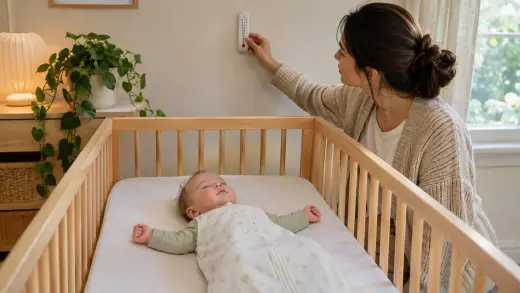
Babies cannot control their body heat as well as adults. Getting too hot raises the risk of SIDS. The Lullaby Trust suggests keeping the room around 16 to 20°C as a helpful guide.
You do not need a room thermometer if you check your baby directly. Feel the back of their neck or their tummy with your hand. It should feel warm, not sweaty or hot. Do not worry if their hands or feet feel cool, as that is normal.
Dress your baby in light layers. Never put a hat, beanie, or hood on your baby for sleep indoors. Babies lose extra heat through their head and face.
Keep the sleep space smoke-free
Keep your baby away from tobacco smoke and vape vapour before and after birth. Do not let anyone smoke near your baby, in the house, or in the car. Smoke makes it harder for babies to wake up if their breathing slows.
Building a calm bedtime routine
A bedtime routine is a short set of quiet steps you repeat every night. It tells your baby's brain that daytime play is over and sleep is next. You do not need anything fancy or expensive.
Keep the routine short, around 20 to 30 minutes. If it drags on too long, your baby may get overtired and cranky. Here is an easy order that works for many families:
- Give a warm bath. Warm water helps your baby relax. If you do not bathe your baby every night, wipe their face and hands with a warm cloth instead.
- Put on a fresh nappy and pyjamas. Use a clean nappy (or diaper) made for overnight if your baby leaks. Dress them in comfortable sleep clothes and a sleeping bag if you use one.
- Dim the lights. Turn off bright overhead lights and screens. Soft, warm lamp light helps your baby's brain make melatonin, the sleep hormone.
- Offer a quiet feed. Give a breastfeed or bottle feed in the quiet bedroom. Keep talking low and gentle.
- Share a cuddle, book, or song. Hold your baby close for a few minutes. Read a short board book or hum a slow lullaby.
- Lay your baby down in the cot. Place them on their back while they are calm and sleepy. Say the same short goodnight phrase each night.
Try to start the routine around the same time each evening. Predictable steps help your baby feel safe. Over a few weeks, your baby will start to yawn as soon as the routine begins.
Helping your baby learn day from night
Newborns do not produce much melatonin yet. They rely on light, noise, and your daily rhythm to set their body clock. You can gently teach your baby the difference between day and night from the very first week.
Make daytime bright and social
Open the curtains in the morning. Take your baby outside for fresh air and natural daylight when the weather is safe. Natural morning light is one of the strongest signals for setting a healthy sleep rhythm.
During the day, talk, sing, and play with your baby while they are awake. Give them plenty of tummy time on a firm mat on the floor while you watch them. Daytime naps do not need to be in a pitch-black, silent room for young newborns.
Make nighttime dark and boring
When your baby wakes at night, keep the room as dark as you can. Use a dim nightlight only if you need to see for feeding or changing. Avoid turning on bright hallway lights or looking at bright phone screens near your baby.
Change their nappy only if it is soiled or soaked through. Use a quiet voice and gentle movements. Do not play games, tickle, or chat excitedly at 2:00 AM. Your baby will soon learn that nighttime is only for feeding and sleeping.
Spotting tired signs before overtiredness hits
Putting a baby down at the right time makes falling asleep much easier. If you wait until your baby is screaming, their body releases stress hormones like cortisol. Those hormones give them a burst of energy and make it hard to settle.
Watch your baby, not just the clock. Early tired signs look subtle:
- Looking away from toys or faces
- Staring blankly into space
- Quiet grizzling or fussing
- Rubbing eyes or pulling at ears
- Slowing down movements
Late tired signs mean your baby is already overtired:
- Yawning over and over
- Clenching fists or arching their back
- Crying hard and turning away from comfort
When you see early tired signs, start winding down right away. Move to a quiet room, dim the lights, and start your short sleep routine.
Responsive settling and gentle ways to help your baby sleep
Parents often hear strong opinions about "sleep training". You do not have to leave a young baby to cry alone. Health services like Pregnancy, Birth and Baby in Australia, the NHS in the UK, and the Canadian Paediatric Society support responsive settling.
Responsive settling means noticing your baby's cues and helping them feel calm and safe. As your baby gets older, you can slowly give them a little space to practise falling asleep on their own.
What "drowsy but awake" means
When your baby is around three or four months old, you can try putting them in the cot when they are sleepy, not fast asleep. This helps them learn what their cot feels like while they are still awake.
Why does this help? Think of it like falling asleep in your bed and waking up on the front lawn. You would feel shocked and call out. If a baby falls asleep in your arms and wakes up alone in a cot, they may cry because things look different.
If your baby cries right away when you put them down, pick them up or pat them calmly. Try again at the next nap or bedtime. It takes practice, not perfection.
Hands-on comfort in the cot
If your baby fusses in the cot, you can comfort them without picking them up straight away. Place a gentle hand on their tummy or chest. Use a slow, steady patting or rhythmic shushing sound.
Keep your voice low and calm. Once your baby's breathing slows and they relax, stop patting and rest your hand there for a moment. Then step back quietly.
Giving a short pause at night
When your baby wakes at night after three or four months, pause for a minute before rushing in. Babies often grunt, sigh, or whimper in their light sleep. Sometimes they are still half asleep and will settle back down on their own.
If the cry grows louder or sounds distressed, go to them right away. Check if they are hungry, wet, too hot, or too cold. Offer comfort calmly and keep the room dark.
Using a dummy (pacifier) safely
If your baby uses a dummy (pacifier), you can offer it at sleep times. Wait until breastfeeding is going well first, usually around four to six weeks, if you are breastfeeding. Never force a baby to take a dummy, and do not coat it in honey or sugar.
If the dummy falls out after your baby is asleep, you do not need to put it back in. Never tie a dummy to your baby's clothes or cot with a cord or ribbon, as cords are a strangulation risk.
Safe sleep rules in Australia, the UK, the US and Canada
Families reading BabyGearFinder live all over the English-speaking world. While words differ—cot or crib, dummy or pacifier, nappy or diaper—the core safe sleep rules are almost the same everywhere.
| Topic | Australia (Red Nose / ACCC) | UK (NHS / Lullaby Trust) | US (AAP / CPSC) | Canada (Health Canada / CPS) |
|---|---|---|---|---|
| Sleep position | Back only for every sleep | Back only for every sleep | Back only for every sleep | Back only for every sleep |
| Cot safety standard | AS/NZS 2172 (cots); AS/NZS 8811.1 (firmness) | BS EN 716 (cots); BS EN 1130 (cribs) | ASTM F1169 (cribs); ASTM F2194 (bassinets) | Meets Canadian crib and cradle safety rules |
| Sleep surface | Firm, flat, clear cot | Firm, flat, waterproof mattress; clear cot | Firm, flat, level surface; empty crib | Firm, flat mattress; no loose items |
| Room sharing | Recommended for first 6 to 12 months | Recommended for at least first 6 months | Recommended for at least first 6 months | Recommended for first 6 months |
| Sleep bags | Fitted neck and armholes, no hood | BS EN 16781; right size and TOG | Wearable blanket; no weighted sleep sacks | Fitted sleep sack; arms out once rolling |
Notice how every country warns against loose blankets, pillows, bumpers, and inclined sleepers. Babies should always sleep flat on their back, never propped up on a pillow, swing, or car seat at home.
Why babies still wake up at night
Even with a great routine, babies are not robots. Sleep goes up and down during the first two years. Here are the most common reasons a baby starts waking again.
Hunger and growth spurts
Babies grow in sudden bursts. During a growth spurt, your baby may need extra milk at night for a few days. Feed them when they show hunger cues, and sleep usually settles again once the spurt passes.
Around six months, starting solid foods does not magically make a baby sleep all night. Milk is still their main food for the first year. Do not add rice cereal to a bottle to make your baby sleep longer, as this is a choking risk and does not improve sleep.
Teething and minor illness
Sore gums, a blocked nose, or a mild fever can wake any baby. Comfort your baby with extra cuddles when they feel unwell. If your baby has a fever, seems in pain, or refuses feeds, check with a doctor or nurse.
Learning new physical skills
When babies learn to roll, sit, crawl, or stand, their brains stay busy at night. You might walk into the nursery and find your baby standing up in the cot, crying because they forgot how to sit back down. Practise those new skills plenty during the day so they feel less new at night.
Too much or too little daytime sleep
Daytime naps and night sleep affect each other. If a baby naps too little, they get overtired and wake more at night. If an older baby naps too late in the afternoon, they may not feel sleepy at bedtime.
Adjust nap times slowly, by 15 minutes every few days, if bedtime becomes a battle.
Common mistakes that make night sleep harder
Tired parents will try almost anything for one more hour of sleep. Some common habits feel helpful at first, but end up making sleep harder or less safe.
- Using sleep positioners, wedges, or nests: Health agencies in all four countries warn against nests, pods, and wedges in the cot. They raise the risk of suffocation.
- Leaving baby to sleep in a car seat or bouncer at home: Car seats are for travel. When a baby sleeps slumped forward in a seat or bouncer, their chin can drop to their chest and block their airway. Move a sleeping baby to a flat cot when you get home.
- Using weighted swaddles or weighted blankets: The American Academy of Pediatrics and US safety officials warn that weighted sleep products are unsafe for babies.
- Playing loud white noise too close: Soft background sound can help soothe a baby, but loud machines placed right next to the cot can harm baby hearing. Keep any sound machine across the room and at a low volume.
- Using screens before bed: Bright screens from phones, tablets, or TVs suppress melatonin and make it harder for babies and toddlers to wind down. Keep screens off in the hour before bed.
- Changing routines every few days: Babies need time to learn new habits. Try any gentle change for at least one to two weeks before deciding it does not work.
Taking care of yourself when you are exhausted
Sleep loss is hard on parents. When you are running on broken sleep, every small task feels huge. Looking after yourself helps you look after your baby safely.
- Take turns if you have a partner: Split the night into shifts so each person gets one solid block of sleep.
- Nap when you can: Even a 20-minute rest during a daytime nap can help you cope.
- Accept simple help: Let friends or family drop off a meal, fold laundry, or hold the baby while you shower and rest.
- Put the baby down if you feel overwhelmed: If your baby will not stop crying and you feel angry or about to lose control, place your baby safely on their back in the cot. Step into another room for a few minutes to breathe and calm down. Never shake a baby.
When to ask a doctor or nurse for help
Most night waking is normal baby behaviour. Still, some signs mean it is wise to speak with your doctor, midwife, health visitor, or child health nurse.
Book a check-up if your baby:
- snores loudly or seems to gasp or pause while breathing in sleep;
- sweats heavily every night even in a cool room;
- cries in pain for hours and cannot be comforted;
- is not gaining weight well or has very few wet nappies;
- always arches their back and brings up feeds in distress.
Also reach out for support if you feel sad, hopeless, or anxious most days. Postnatal depression and anxiety are common and treatable. Talking to your doctor or a free parent helpline can make a real difference.
Frequently asked questions
At what age do babies usually sleep through the night?
Many babies start sleeping for five or six hours at a stretch between four and six months old. Others still wake once or twice a night until they are one year old or older. Both are normal.
Should I wake a newborn to feed at night?
In the first few weeks, yes, if your midwife or doctor tells you to. Newborns need frequent feeds until they regain their birth weight and gain weight steadily. Once your doctor says weight gain is on track, you can usually let your baby sleep until they wake.
Is it safe to swaddle my baby to help them sleep longer?
Swaddling with a thin cotton or muslin wrap can help calm the newborn startle reflex. Keep the wrap below the shoulders, loose at the hips, and always lay your baby on their back. Stop swaddling as soon as your baby shows any sign of trying to roll.
Do baby breathing monitors prevent SIDS?
No. Health bodies like Red Nose, The Lullaby Trust, and the American Academy of Pediatrics say home breathing or oxygen monitors do not prevent SIDS. Safe sleep practices—back to sleep, clear cot, smoke-free home, and room sharing—are what protect your baby.
Will starting solid foods help my baby sleep through the night?
Not usually. Around six months, babies start solids for nutrition and learning to eat, not to sleep longer. Some babies even wake more for a short time while their tummy gets used to new foods.
How dark should the bedroom be for sleep?
At night, keep the room dark so your baby knows it is time for long sleep. Use a very dim, warm-toned nightlight only if you need to see for nappy changes or feeds. During the day, newborns can nap in normal daylight, though older babies often nap better in a dim room.
Sources
- Pregnancy, Birth and Baby – Getting your baby to sleep
- Pregnancy, Birth and Baby – Baby sleep patterns by age
- Red Nose Australia – Six safe sleep recommendations
- NHS – Helping your baby to sleep
- The Lullaby Trust – Safer sleep overview
- AAP HealthyChildren.org – Getting your baby to sleep
- American Academy of Pediatrics (US) – A parent's guide to safe sleep
- Caring for Kids (Canadian Paediatric Society) – Healthy sleep for your baby and child
Related guides
More Parental Tips →
From Breast Milk to Solids: A Simple Guide to Feeding Your Baby
How to Dress Your Baby for Sleep in Every Season: Room Temperature and TOG Guide

How to Set Up a Safe Hotel or Airbnb Sleep Space for Your Baby
